**Astronomy Picture of the Day**

npub1ap0dw55xedm5w4mkcyq8m7xyluwfc680lywrvfe50vr9ckl5m3uqtf5l75
hex
3889d783d4c718e360d7de637050f63b7f9f9f08f672204c03aee29b48e170adnevent
nevent1qqsr3zwhs02vwx8rvrtaucms2rmrklulnuy0vu3qfsp6ac5mfrshptgprpmhxue69uhhyetvv9ujuem4d36kwatvw5hx6mm9qgswshkh22rvka682amvzqralrz078yudrhlj8pkyu68kpjut06dc7qhj87cqKind-1 (TextNote)
Astronomy Picture of the Day
20 March 2026
Spring Equinox at Teide Observatory
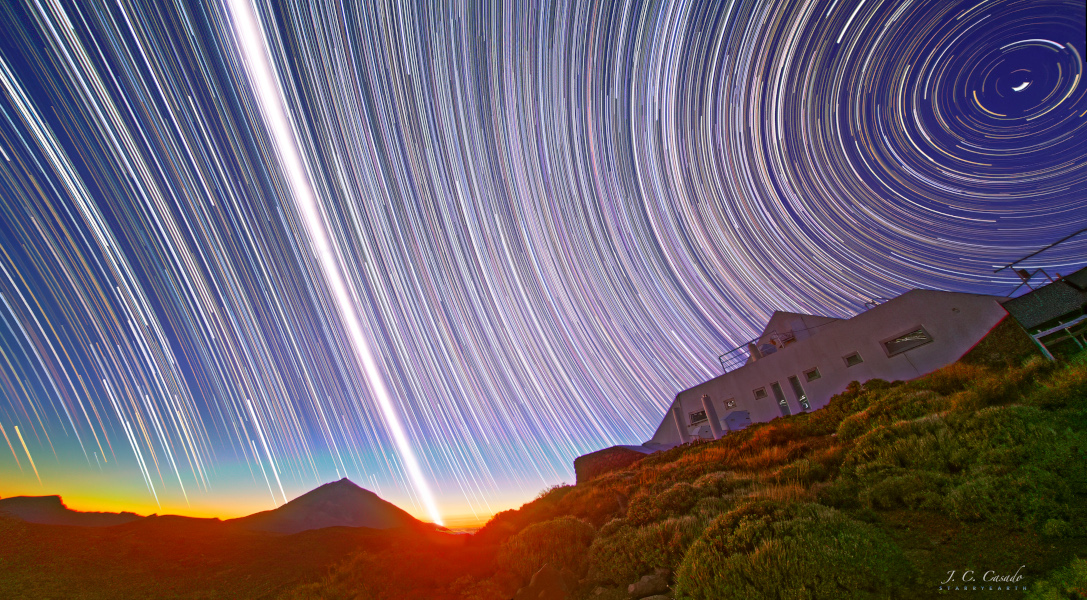
Image Credit: Juan Carlos Casado, Starry Earth, TWAN
Explanation:
The defining astronomical moment of the equinox today is at 14:46 UTC (March 20).
That's when the Sun crosses the celestial equator moving north in its yearly journey through planet Earth's sky, marking the beginning of spring for our fair planet in the northern hemisphere and fall in the southern hemisphere.
Then, day and night are nearly equal around the globe.
In fact, both day and nighttime exposures from a spring equinox at the Observatorio del Teide in Tenerife, Canary Islands, Spain, are used in this composited skyscape.
Over 1,000 images were taken with a fisheye lens and merged in the ambitious equinox project.
The apparent motion of the Sun setting along the celestial equator on the equinox date follows the bright linear, diagonal track from the sequence of daytime exposures taken over 6 hours.
After sunset, nighttime exposures recorded startrails, with the celestial equator as a linear track and concentric arcs circling the north celestial pole near Polaris at upper right and the south celestial pole beyond the lower left edge (and below the Teide horizon).
The foreground includes the distant Teide volcano peak and the observatory's pyramid-shaped solar laboratory building.
#APOD #SpringEquinox #TeideObservatory #ObservatorioDelTeide #CelestialEquator #Equinox2024
https://apod.nasa.gov/apod/ap260320.html
原始 JSON
{
  "kind": 1,
  "id": "3889d783d4c718e360d7de637050f63b7f9f9f08f672204c03aee29b48e170ad",
  "pubkey": "e85ed75286cb77475776c1007df8c4ff1c9c68eff91c3627347b065c5bf4dc78",
  "created_at": 1773979713,
  "tags": [],
  "content": "**Astronomy Picture of the Day**\n\n20 March 2026\n\n**Spring Equinox at Teide Observatory**\n\nhttps://apod.nasa.gov/apod/image/2603/equinox-3k-jcc_1087c.jpg\n\nImage Credit: Juan Carlos Casado, Starry Earth, TWAN\n\nExplanation:  \n\nThe defining astronomical moment\nof the equinox today is at 14:46 UTC (March 20).\n\nThat's when the Sun\ncrosses the celestial equator moving north\nin its yearly journey through planet Earth's sky, marking\nthe beginning of spring for our fair planet in the northern\nhemisphere and fall in the southern hemisphere. \n\nThen, day and night are nearly equal\naround the globe.\n\nIn fact, both day and nighttime exposures from a spring equinox at the\nObservatorio del Teide\nin Tenerife, Canary Islands, Spain, are used in this composited skyscape.\n\nOver 1,000 images were taken with a fisheye lens and merged\nin the ambitious equinox project.\n\nThe apparent motion of the Sun setting along the celestial equator on\nthe equinox date follows the bright linear, diagonal track from\nthe sequence of daytime exposures taken over 6 hours.\n\nAfter sunset, nighttime exposures recorded startrails,\nwith the\ncelestial equator as a linear track and concentric\narcs circling the north celestial pole near Polaris at upper\nright and the south celestial pole beyond the lower left edge\n(and below the Teide horizon).\n\nThe foreground includes the distant\nTeide volcano peak\nand the\nobservatory's pyramid-shaped solar laboratory building.\n\n#APOD #SpringEquinox #TeideObservatory #ObservatorioDelTeide #CelestialEquator #Equinox2024\n\nhttps://apod.nasa.gov/apod/ap260320.html\n",
  "sig": "5e731b04049fe167d060b3dda3ff310bee8de19334dd3cdf0bf13e4067cb631a859677fe60f38e610a384e99f7e6667d87611586afd05975aa138db81349b209"
}