**Astronomy Picture of the Day**

npub1ap0dw55xedm5w4mkcyq8m7xyluwfc680lywrvfe50vr9ckl5m3uqtf5l75
hex
78c8b11cda60a3e5d85a018b2f0a8d64c2aaef59baaca14afd201da950265121nevent
nevent1qqs83j93rndxpgl9mpdqrze0p2xkfs42aavm4t9pft7jq8df2qn9zggprpmhxue69uhhyetvv9ujuem4d36kwatvw5hx6mm9qgswshkh22rvka682amvzqralrz078yudrhlj8pkyu68kpjut06dc7qr0ufmzKind-1 (TextNote)
Astronomy Picture of the Day
09 June 2026
Thor's Helmet
Image: 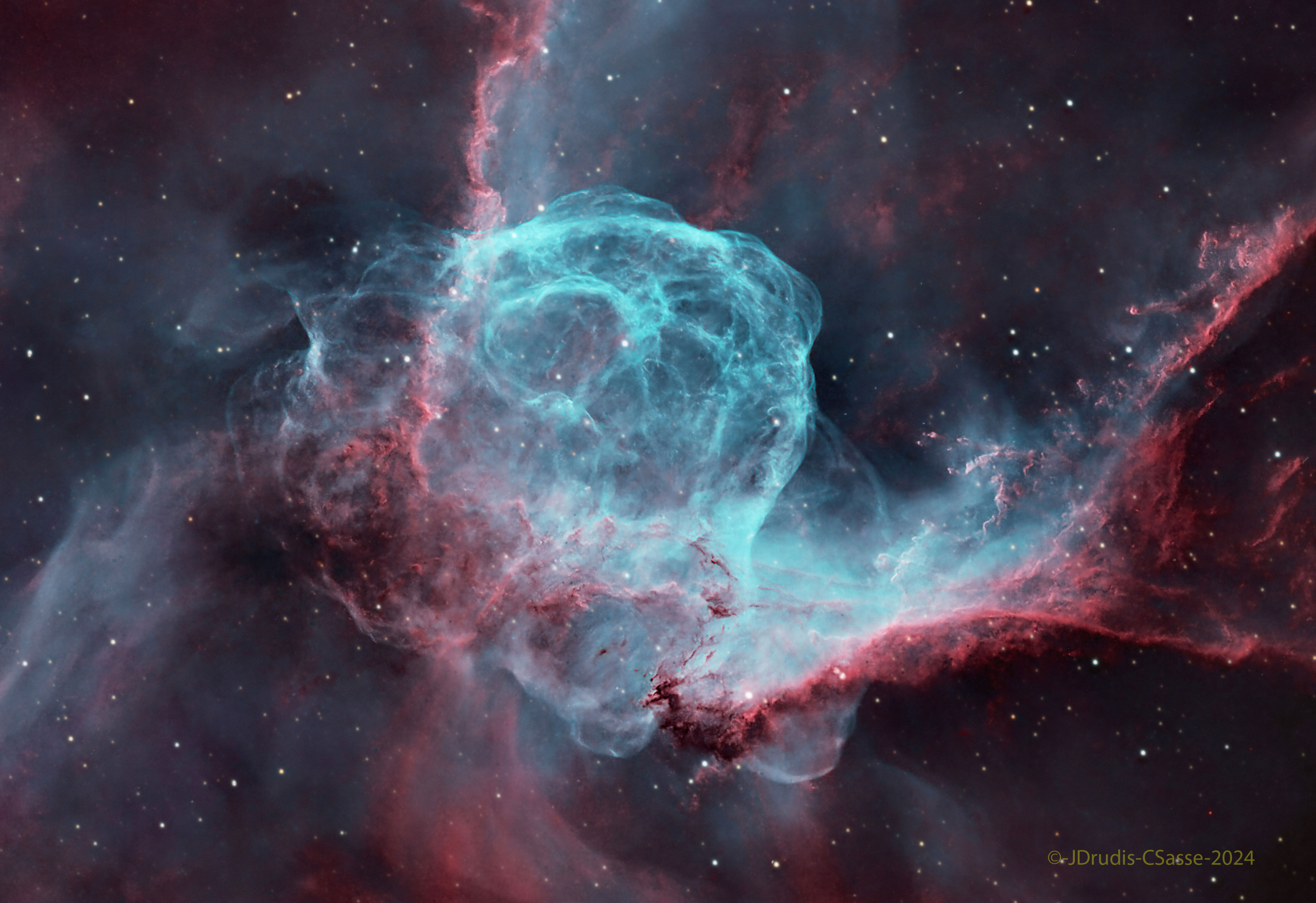
Credit: Not provided
Thor not only has his own day (Thursday), but a helmet in the heavens. Popularly called Thor's Helmet, NGC 2359 is a hat-shaped cosmic cloud with wing -like appendages. Heroically sized even for a Norse god , Thor's Helmet is about 30 light-years across. In fact, the cosmic head-covering is more like an interstellar bubble , blown by a fast wind from the bright, massive star near the bubble's center. Known as a Wolf-Rayet star , the central star is an extremely hot giant thought to be in a brief, pre- supernova stage of evolution . NGC 2359 is located about 15,000 light-years away toward the constellation of the Great Overdog . This sharp image is a combination of deep images taken in light emitted by hydrogen (red) and oxygen (blue). The star in the center of Thor's Helmet is expected to explode in a spectacular supernova sometime within the next few thousand years.
#APOD #Astrophotography #Science #NASAInspires #Space
https://apod.nasa.gov/apod/ap260609.html
原始 JSON
{
  "kind": 1,
  "id": "78c8b11cda60a3e5d85a018b2f0a8d64c2aaef59baaca14afd201da950265121",
  "pubkey": "e85ed75286cb77475776c1007df8c4ff1c9c68eff91c3627347b065c5bf4dc78",
  "created_at": 1780978212,
  "tags": [],
  "content": "**Astronomy Picture of the Day**\n\n09 June 2026\n\n**Thor's Helmet**\n\nImage: https://apod.nasa.gov/apod/image/2606/Thor_Drudis_4389.jpg\n\nCredit: Not provided\n\nThor not only has his own day (Thursday), but a helmet in the heavens. Popularly called Thor's Helmet, NGC 2359 is a hat-shaped cosmic cloud with wing -like appendages. Heroically sized even for a Norse god , Thor's Helmet is about 30 light-years across. In fact, the cosmic head-covering is more like an interstellar bubble , blown by a fast wind from the bright, massive star near the bubble's center. Known as a Wolf-Rayet star , the central star is an extremely hot giant thought to be in a brief, pre- supernova stage of evolution . NGC 2359 is located about 15,000 light-years away toward the constellation of the Great Overdog . This sharp image is a combination of deep images taken in light emitted by hydrogen (red) and oxygen (blue). The star in the center of Thor's Helmet is expected to explode in a spectacular supernova sometime within the next few thousand years.\n\n#APOD #Astrophotography #Science #NASAInspires #Space\n\nhttps://apod.nasa.gov/apod/ap260609.html\n",
  "sig": "946b611e0ee5ecfa7f3ce6dc95feea6c7d163b5dade6e2ec11c718ced206b3ccaa009c735ce2ac62e075d0239f474464bc8d7b6ddfe9602bddb4323a4c7ac234"
}