**Astronomy Picture of the Day**

npub1ap0dw55xedm5w4mkcyq8m7xyluwfc680lywrvfe50vr9ckl5m3uqtf5l75
hex
991917f7d15059dc21ce5f0b5d9a01485f5ea89ba74a93ae170289dbbb45387cnevent
nevent1qqsfjxgh7lg4qkwuy8897z6angq5sh674zd6wj5n4cts9zwmhdznslqprpmhxue69uhhyetvv9ujuem4d36kwatvw5hx6mm9qgswshkh22rvka682amvzqralrz078yudrhlj8pkyu68kpjut06dc7qe8ju8dKind-1 (TextNote)
Astronomy Picture of the Day
02 May 2026
Seeing Titan
Image: 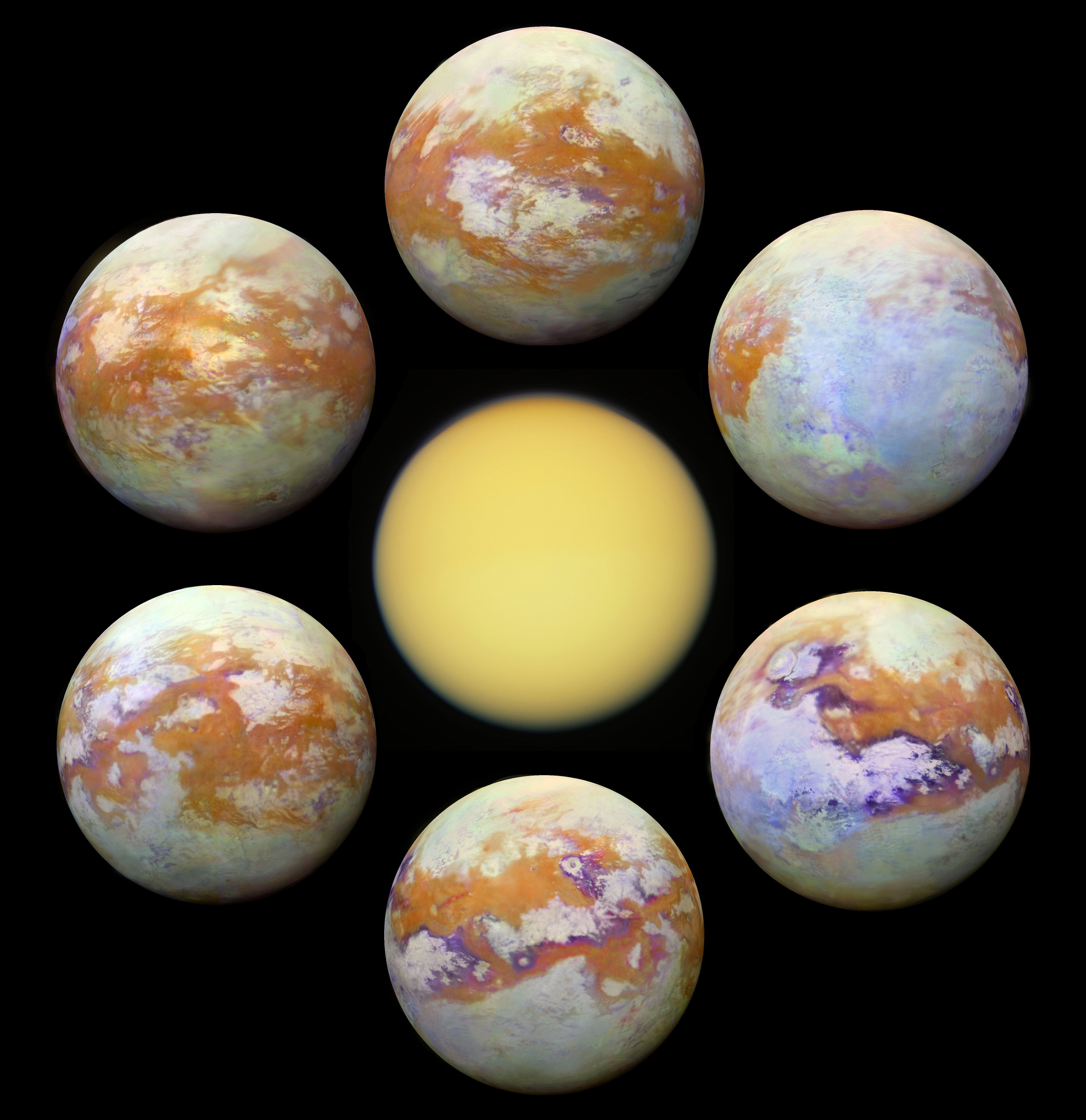
Image Credit: VIMS Team, Univ. Arizona , U. Nantes , ESA , NASA
Shrouded in a thick atmosphere, the surface of Saturn's largest moon, Titan , is really hard to see. Small particles suspended in Titan's upper atmosphere cause an almost impenetrable haze, strongly scattering light at visible wavelengths and hiding surface features from prying eyes. Still, Titan's surface is better imaged at infrared wavelengths, where scattering is weaker and atmospheric absorption is reduced. Arrayed around this visible light image (center) of Titan are some of the clearest global infrared views of the tantalizing moon so far. In false color, the six panels present a consistent processing of 13 years of infrared image data from the Visual and Infrared Mapping Spectrometer (VIMS) on board the Cassini spacecraft orbiting Saturn from 2004 to 2017. They offer a stunning comparison with Cassini's visible light view. NASA's revolutionary rotorcraft mission to Titan's surface is due to launch no earlier than July, 2028.
#APOD #Titan #Saturn #Cassini #VIMS #InfraredAstronomy
https://apod.nasa.gov/apod/ap260502.html
原始 JSON
{
  "kind": 1,
  "id": "991917f7d15059dc21ce5f0b5d9a01485f5ea89ba74a93ae170289dbbb45387c",
  "pubkey": "e85ed75286cb77475776c1007df8c4ff1c9c68eff91c3627347b065c5bf4dc78",
  "created_at": 1777694859,
  "tags": [],
  "content": "**Astronomy Picture of the Day**\n\n02 May 2026\n\n**Seeing Titan**\n\nImage: https://apod.nasa.gov/apod/image/2605/PIA21923_fig1SeeingTitan2400.jpg\n\nImage Credit: VIMS Team, Univ. Arizona , U. Nantes , ESA , NASA\n\nShrouded in a thick atmosphere, the surface of Saturn's largest moon, Titan , is really hard to see. Small particles suspended in Titan's upper atmosphere cause an almost impenetrable haze, strongly scattering light at visible wavelengths and hiding surface features from prying eyes. Still, Titan's surface is better imaged at infrared wavelengths, where scattering is weaker and atmospheric absorption is reduced. Arrayed around this visible light image (center) of Titan are some of the clearest global infrared views of the tantalizing moon so far. In false color, the six panels present a consistent processing of 13 years of infrared image data from the Visual and Infrared Mapping Spectrometer (VIMS) on board the Cassini spacecraft orbiting Saturn from 2004 to 2017. They offer a stunning comparison with Cassini's visible light view. NASA's revolutionary rotorcraft mission to Titan's surface is due to launch no earlier than July, 2028.\n\n#APOD #Titan #Saturn #Cassini #VIMS #InfraredAstronomy\n\nhttps://apod.nasa.gov/apod/ap260502.html\n",
  "sig": "4f60e0f349f6350d92b0cce1dc46db117f9960466c2dc324ed2ae5c0a63ec15e3d241abe80b78c1aee28c0df35e2d04bd0d045fc8ff98e34186d9b920b63f975"
}