**Astronomy Picture of the Day**

npub1ap0dw55xedm5w4mkcyq8m7xyluwfc680lywrvfe50vr9ckl5m3uqtf5l75
hex
b5720422be33fe9559b3451e72cd80931a67304280275676cd6f6426692569a9nevent
nevent1qqst2usyy2lr8l54txe528njekqfxxn8xppgqf6kwmxk7epxdyjkn2gprpmhxue69uhhyetvv9ujuem4d36kwatvw5hx6mm9qgswshkh22rvka682amvzqralrz078yudrhlj8pkyu68kpjut06dc7qpg2euqKind-1 (TextNote)
Astronomy Picture of the Day
21 April 2026
Comet R3 PanSTARRS over a Himalayan Valley
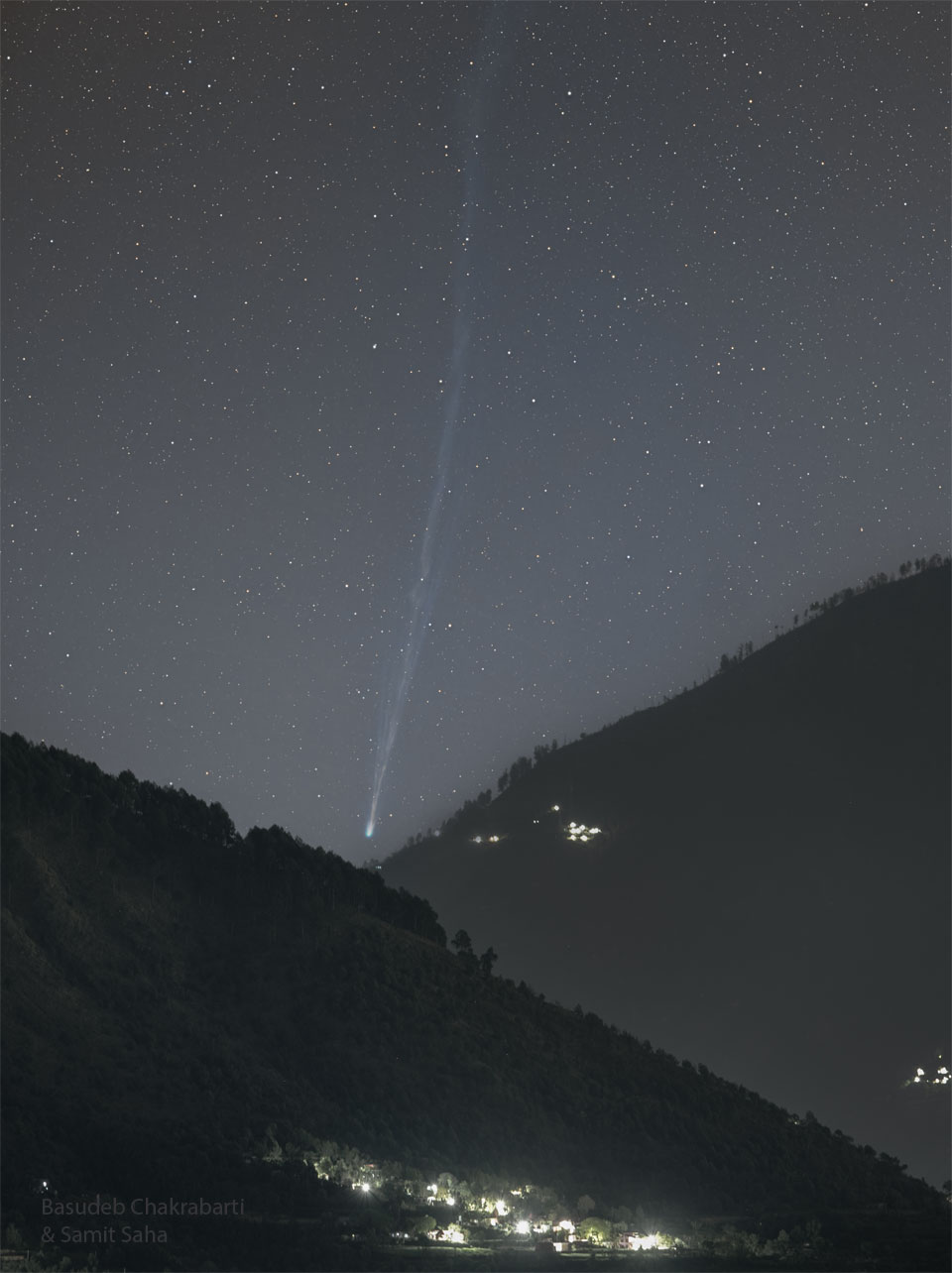
Image Credit: Basudeb Chakrabarti, Samit Saha
Explanation:
The best way to see comet R3 PanSTARRS’s long tail is with a camera.
This week, the recently brightened comet appears in northern skies to the east just before dawn, but is only barely visible to the unaided eye.
The many-degree ion tail captured on long duration camera exposures is not unusual for a comet - it is primarily due to the Earth's nearly sideways view of the tail as it points away from the Sun.
In the featured image taken last week, Comet C/2025 R3 (PanSTARRS) showed off its flowing tail through a valley between two peaks in the Himalayan mountains of India.
The comet passed its closest to the Sun yesterday.
As it nears its closest approach to Earth next week, a bushy dust tail may become visible.
The comet is slowly moving out of northern skies and by the end of the month will be visible after sunset in southern skies as it fades and leaves our Solar System.
#APOD #CometR3 #PanSTARRS #C2025R3 #HimalayanValley #NorthernSkies
https://apod.nasa.gov/apod/ap260420.html
原始 JSON
{
  "kind": 1,
  "id": "b5720422be33fe9559b3451e72cd80931a67304280275676cd6f6426692569a9",
  "pubkey": "e85ed75286cb77475776c1007df8c4ff1c9c68eff91c3627347b065c5bf4dc78",
  "created_at": 1776745443,
  "tags": [],
  "content": "**Astronomy Picture of the Day**\n\n21 April 2026\n\n**Comet R3 PanSTARRS over a Himalayan Valley**\n\nhttps://apod.nasa.gov/apod/image/2604/ValleyComet_Chakrabarti_960.jpg\n\nImage Credit: Basudeb Chakrabarti, Samit Saha\n\nExplanation:  \nThe best way to see comet R3 PanSTARRS’s long tail is with a camera.\n\nThis week, the \nrecently brightened comet \nappears in northern skies to the east just before dawn, \nbut is only barely visible to the unaided eye.\n\nThe many-degree \nion tail captured on long duration camera exposures \nis not unusual for a comet - \nit is primarily due to the \nEarth's nearly sideways \nview of the tail as it points away from the Sun. \n\nIn the \nfeatured image taken last week, Comet \nC/2025 R3 (PanSTARRS) showed off its flowing tail \nthrough a valley between two peaks in the \nHimalayan mountains of \nIndia. \u0026nbsp;\n\nThe comet passed its closest to \nthe Sun yesterday.\n\nAs it nears its closest approach to Earth next week, a \nbushy \ndust tail may become visible. \n\nThe comet is slowly moving out of northern skies \nand by the end of the month \nwill be visible after sunset \nin southern skies as it fades and \nleaves our \nSolar System.\u0026nbsp;\n\n#APOD #CometR3 #PanSTARRS #C2025R3 #HimalayanValley #NorthernSkies\n\nhttps://apod.nasa.gov/apod/ap260420.html\n",
  "sig": "481277300df6bb779db713833fd17b1b6e2600fa50caa25f5e0854067ff1de8a05c72c68dfdd5255066908b9daf51492f4fc65dd638e4da6bfb30fb360519945"
}