**Astronomy Picture of the Day**

npub1ap0dw55xedm5w4mkcyq8m7xyluwfc680lywrvfe50vr9ckl5m3uqtf5l75
hex
caf21ac548b4193b9f91078f39e0994db02aff6c8ded4f896a603484c34795adnevent
nevent1qqsv4us6c4ytgxfmn7gs0reeuzv5mvp2lakgmm20394xqdyycdrettgprpmhxue69uhhyetvv9ujuem4d36kwatvw5hx6mm9qgswshkh22rvka682amvzqralrz078yudrhlj8pkyu68kpjut06dc7qd5az83Kind-1 (TextNote)
Astronomy Picture of the Day
01 April 2026
Uranus's Largest Moon: Titania
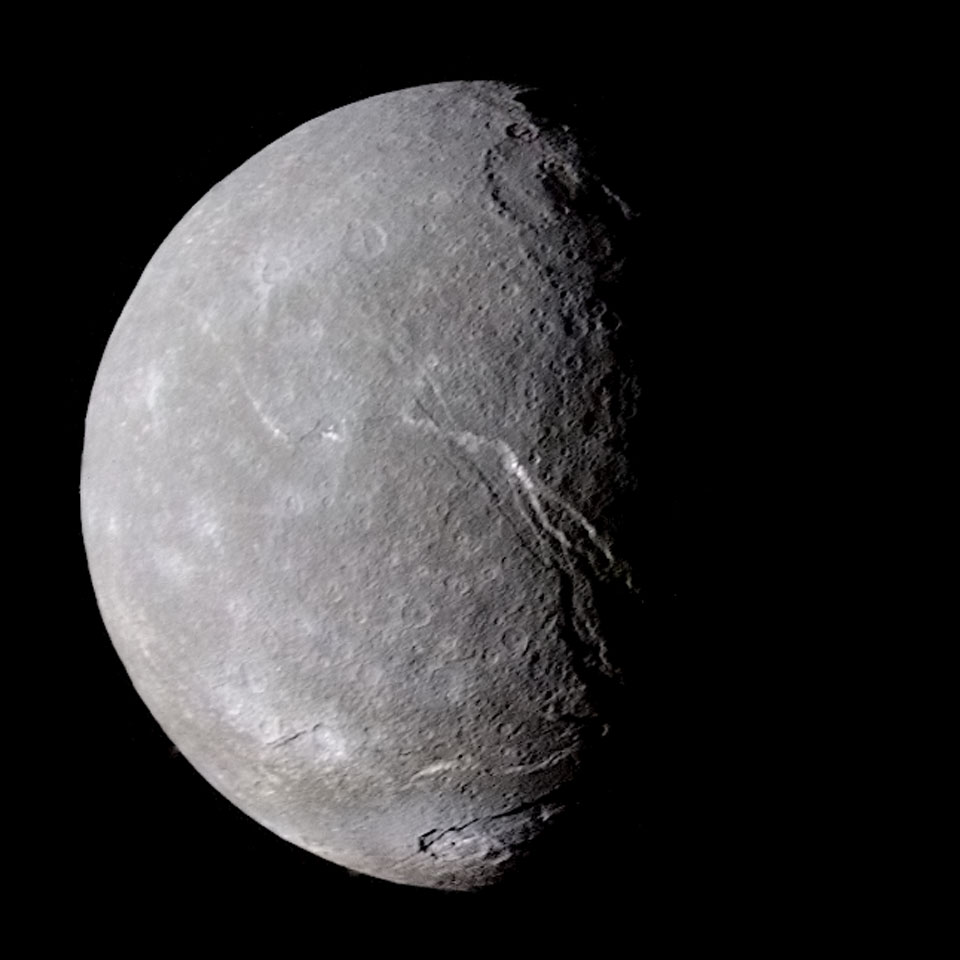
Image Credit: NASA, Voyager 2, zelario12 | License
Explanation:
Titania's tortured terrain is a mix of canyons, cliffs, and craters.
NASA's interplanetary robot spacecraft Voyager 2 passed the largest moon of Uranus in 1986 and took the feature picture.
That the trenches of Titania resemble those on another moon of Uranus, Ariel, indicate that Titania underwent some violent surface event possibly related to water freezing and expanding in its distant past.
Although Titania is Uranus's largest moon, it is only about half the radius of Triton - the largest moon of Uranus's sister planet Neptune, which itself is slightly smaller than Earth's Moon.
Titania, discovered by William Herschel in 1787, is essentially a large dirty iceball that is composed of about half water-ice and half rock.
There is recent speculation that radioactive heating melts some underground ice into oceans.
#APOD #Titania #Uranus #Moon #Voyager2 #NASA
https://apod.nasa.gov/apod/ap260331.html
原始 JSON
{
  "kind": 1,
  "id": "caf21ac548b4193b9f91078f39e0994db02aff6c8ded4f896a603484c34795ad",
  "pubkey": "e85ed75286cb77475776c1007df8c4ff1c9c68eff91c3627347b065c5bf4dc78",
  "created_at": 1775017222,
  "tags": [],
  "content": "**Astronomy Picture of the Day**\n\n01 April 2026\n\n**Uranus's Largest Moon: Titania**\n\nhttps://apod.nasa.gov/apod/image/2603/Titania_Voyager2_960.jpg\n\nImage Credit: NASA, Voyager 2, zelario12 | License\n\nExplanation:  \nTitania's tortured terrain is a mix of canyons, cliffs, and craters. \n\nNASA's interplanetary robot spacecraft \nVoyager 2 passed the largest moon of \nUranus in 1986 and took the \nfeature picture.\n\nThat the\ntrenches of Titania \nresemble those on another moon of Uranus, \nAriel, \nindicate that Titania underwent some violent surface \nevent possibly related to water \nfreezing and expanding in its distant past. \n\nAlthough Titania is Uranus's largest moon, \nit is only about half the radius of \nTriton - \nthe largest moon of Uranus's sister planet \nNeptune, \nwhich itself is \nslightly smaller than \nEarth's Moon. \n\nTitania, \ndiscovered by \nWilliam Herschel \nin 1787, is essentially a large dirty iceball \nthat is composed of about half water-ice and half rock. \n\nThere is recent \nspeculation that \nradioactive heating \nmelts some underground ice into oceans.\n\n#APOD #Titania #Uranus #Moon #Voyager2 #NASA\n\nhttps://apod.nasa.gov/apod/ap260331.html\n",
  "sig": "1c0ae9cf42a5fbc261145d19dc739be180b6f7783ece921db4eca35f9f69ba9c31276a55acaa1d120311aa757a15a356492d01d8c1ad38dd9b2b719ba1e39e51"
}