**Astronomy Picture of the Day**

npub1ap0dw55xedm5w4mkcyq8m7xyluwfc680lywrvfe50vr9ckl5m3uqtf5l75
hex
dca834e9a676738ebf3aaa4ce5d36d1e794316cd1789c2c8e2955640f3e85b98nevent
nevent1qqsde2p5axn8vuuwhua25n896dk3u72rzmx30zwzer3f24jq7059hxqprpmhxue69uhhyetvv9ujuem4d36kwatvw5hx6mm9qgswshkh22rvka682amvzqralrz078yudrhlj8pkyu68kpjut06dc7qdntnrwKind-1 (TextNote)
Astronomy Picture of the Day
24 March 2026
Light Pillars and Orion over Mohe
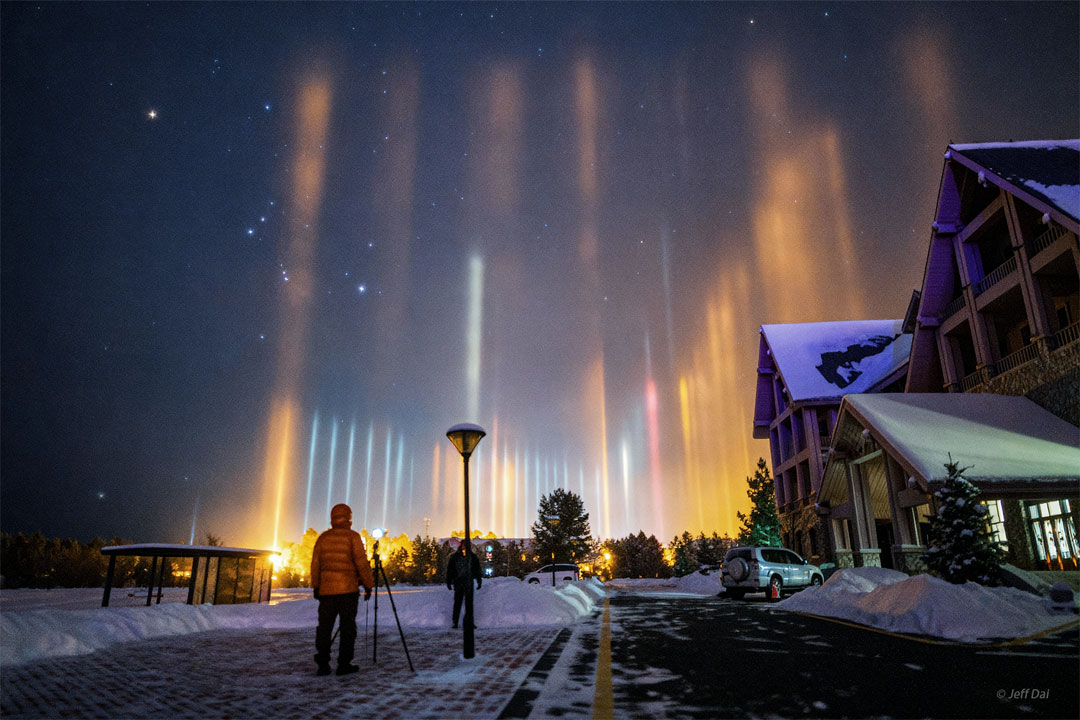
Image Credit: Jeff Dai, TWAN
Explanation:
What's happening at the end of that street?
Pictured here are not auroras but light pillars, a phenomenon typically much closer.
In most places on Earth, a lucky viewer can see a Sun pillar, a column of light appearing to extend up from the Sun caused by flat fluttering ice-crystals reflecting sunlight from the upper atmosphere.
Usually, these ice crystals evaporate before reaching the ground.
During freezing temperatures, however, flat fluttering ice crystals may form near the ground and are sometimes known as a crystal fog.
These small ice crystals may then reflect not the Sun but ground lights.
The featured image captured not only numerous light pillars but also the iconic constellation of Orion, and was taken in Mohe, the northernmost city in China.
#APOD lookUp #NASA Astrophotography #Astrophoto
https://apod.nasa.gov/apod/ap260323.html
原始 JSON
{
  "kind": 1,
  "id": "dca834e9a676738ebf3aaa4ce5d36d1e794316cd1789c2c8e2955640f3e85b98",
  "pubkey": "e85ed75286cb77475776c1007df8c4ff1c9c68eff91c3627347b065c5bf4dc78",
  "created_at": 1774325650,
  "tags": [],
  "content": "**Astronomy Picture of the Day**\n\n24 March 2026\n\n**Light Pillars and Orion over Mohe**\n\nhttps://apod.nasa.gov/apod/image/2603/LightPillarsMohe_Dai_1080.jpg\n\nImage Credit: Jeff Dai, TWAN\n\nExplanation:  \nWhat's happening at the end of that street? \n\nPictured here are not \nauroras but \nlight pillars, a phenomenon typically much closer. \n\nIn most places on \nEarth, a lucky viewer can see a \nSun pillar, \na column of light appearing to extend up from the \nSun \ncaused by flat fluttering \nice-crystals reflecting sunlight from the \nupper atmosphere. \n\nUsually, these ice \ncrystals \nevaporate before reaching the ground. \n\nDuring freezing temperatures, however, \nflat \nfluttering \nice crystals may form near the ground and are sometimes known as a \ncrystal fog. \n\nThese small ice crystals may then reflect not the Sun but \nground lights. \n\nThe featured image captured not only \nnumerous light pillars but also the iconic \nconstellation of Orion, and was taken in \nMohe, the northernmost city in \nChina.\n\n#APOD lookUp #NASA Astrophotography #Astrophoto\n\nhttps://apod.nasa.gov/apod/ap260323.html\n",
  "sig": "36d50210b80c877b33b28e643b7f50a156f65d254f280989e35491e9a8fb9c595a787ede4b79259b9b1e92b2e9d105d98820f9ac467776c8f1f3bfe607f57907"
}