**Astronomy Picture of the Day**

npub1ap0dw55xedm5w4mkcyq8m7xyluwfc680lywrvfe50vr9ckl5m3uqtf5l75
hex
f0e4a62c3b313e0d894de380ceeaf4ff79d6674ed27a070228b3189229f0714fnevent
nevent1qqs0pe9x9sanz0sd39x78qxwat6077wkva8dy7s8qg5txxyj98c8zncprpmhxue69uhhyetvv9ujuem4d36kwatvw5hx6mm9qgswshkh22rvka682amvzqralrz078yudrhlj8pkyu68kpjut06dc7qz85uhjKind-1 (TextNote)
Astronomy Picture of the Day
14 April 2026
NGC 602 and Beyond
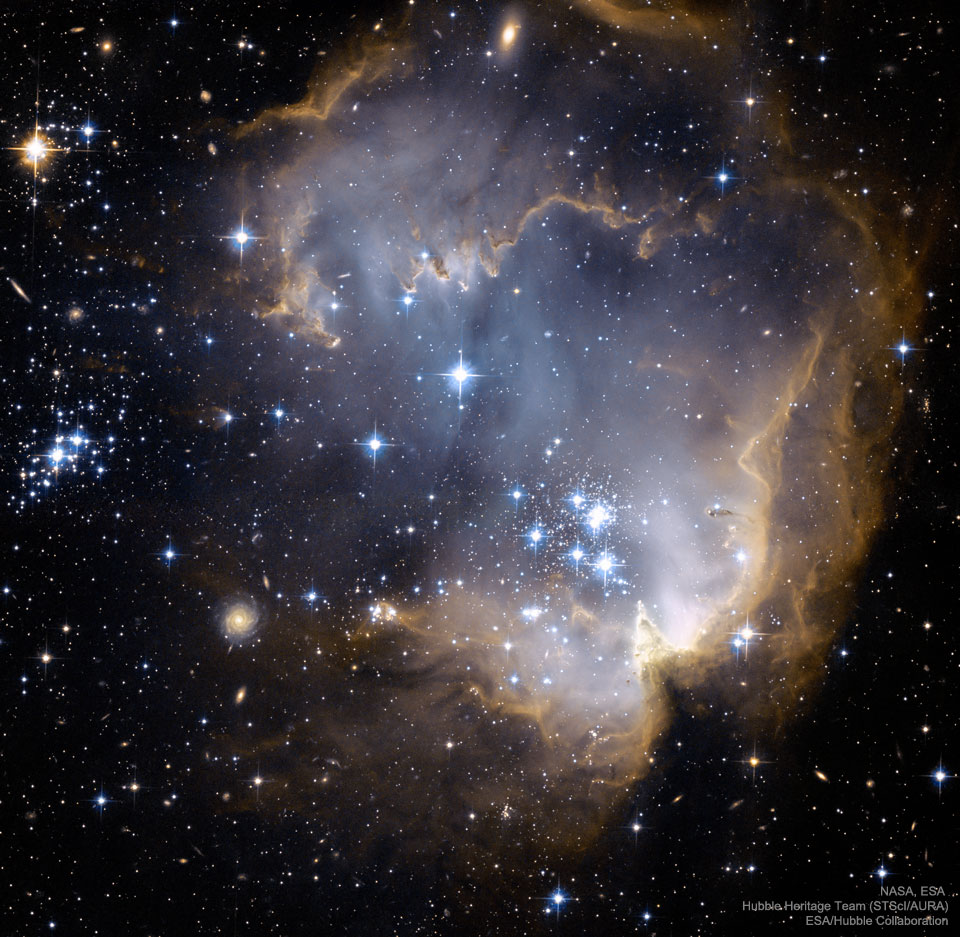
Image Credit: NASA, ESA, Hubble Heritage, STScI, AURA, ESA
Explanation:
The clouds may look like an oyster, and the stars like pearls, but look beyond.
Near the outskirts of the Small Magellanic Cloud, a satellite galaxy some 200 thousand light-years distant, lies 5 million year young star cluster NGC 602.
Surrounded by natal gas and dust, NGC 602 is featured in this stunning Hubble image of the region.
Fantastic ridges and swept back shapes strongly suggest that energetic radiation and shock waves from NGC 602's massive young stars have eroded the dusty material and triggered a progression of star formation moving away from the cluster's center.
At the estimated distance of the Small Magellanic Cloud, the featured picture spans about 200 light-years, but a tantalizing assortment of background galaxies are also visible in this sharp multi-colored view.
The background galaxies are hundreds of millions of light-years or more beyond NGC 602.
#APOD #NGC602 #SmallMagellanicCloud #HubbleSpaceTelescope #StarFormation #YoungStarCluster
https://apod.nasa.gov/apod/ap260413.html
原始 JSON
{
  "kind": 1,
  "id": "f0e4a62c3b313e0d894de380ceeaf4ff79d6674ed27a070228b3189229f0714f",
  "pubkey": "e85ed75286cb77475776c1007df8c4ff1c9c68eff91c3627347b065c5bf4dc78",
  "created_at": 1776139843,
  "tags": [],
  "content": "**Astronomy Picture of the Day**\n\n14 April 2026\n\n**NGC 602 and Beyond**\n\nhttps://apod.nasa.gov/apod/image/2604/Ngc602_Hubble_960.jpg\n\nImage Credit: NASA, ESA, Hubble Heritage, STScI, AURA, ESA\n\nExplanation:  \nThe clouds may look like an oyster, and the stars like pearls, but look beyond.\n\nNear the outskirts of the\nSmall Magellanic Cloud,\na satellite galaxy some 200 thousand light-years distant,\nlies 5 million year young star cluster \nNGC 602.\n\nSurrounded by natal gas and dust,\nNGC 602 is featured in this\nstunning Hubble image of the region.\n\nFantastic ridges and swept\nback shapes strongly suggest that\nenergetic radiation and shock waves from \nNGC 602's \nmassive young stars have eroded the \ndusty material \nand triggered a progression of \nstar formation moving away from the cluster's center.\n\nAt the estimated distance of the \nSmall Magellanic Cloud, \nthe featured picture spans about 200 light-years, but\na tantalizing assortment of background galaxies are also visible in \nthis sharp \nmulti-colored view.\n\nThe background galaxies are hundreds of\nmillions of \nlight-years or more \nbeyond NGC 602.\n\n#APOD #NGC602 #SmallMagellanicCloud #HubbleSpaceTelescope #StarFormation #YoungStarCluster\n\nhttps://apod.nasa.gov/apod/ap260413.html\n",
  "sig": "f98df6bb88772747808fc3cee6b414ee6db3de05441eb15e359f886317b7399ab1c6946ee292b6fcf1c82b4fa19659d3a572f0944c968ebab79e422adf5d028a"
}