**Astronomy Picture of the Day**

npub1ap0dw55xedm5w4mkcyq8m7xyluwfc680lywrvfe50vr9ckl5m3uqtf5l75
hex
f102b331a16e80d211b8bc6e6cdc18753e7f3f500a1bdfc4586b11a69797fad6nevent
nevent1qqs0zq4nxxskaqxjzxutcmnvmsv820nl8agq5x7lc3vxkydxj7tl44sprpmhxue69uhhyetvv9ujuem4d36kwatvw5hx6mm9qgswshkh22rvka682amvzqralrz078yudrhlj8pkyu68kpjut06dc7q9tjsd4Kind-1 (TextNote)
Astronomy Picture of the Day
28 June 2026
AR 4478: Giant Sunspot Group
Image: 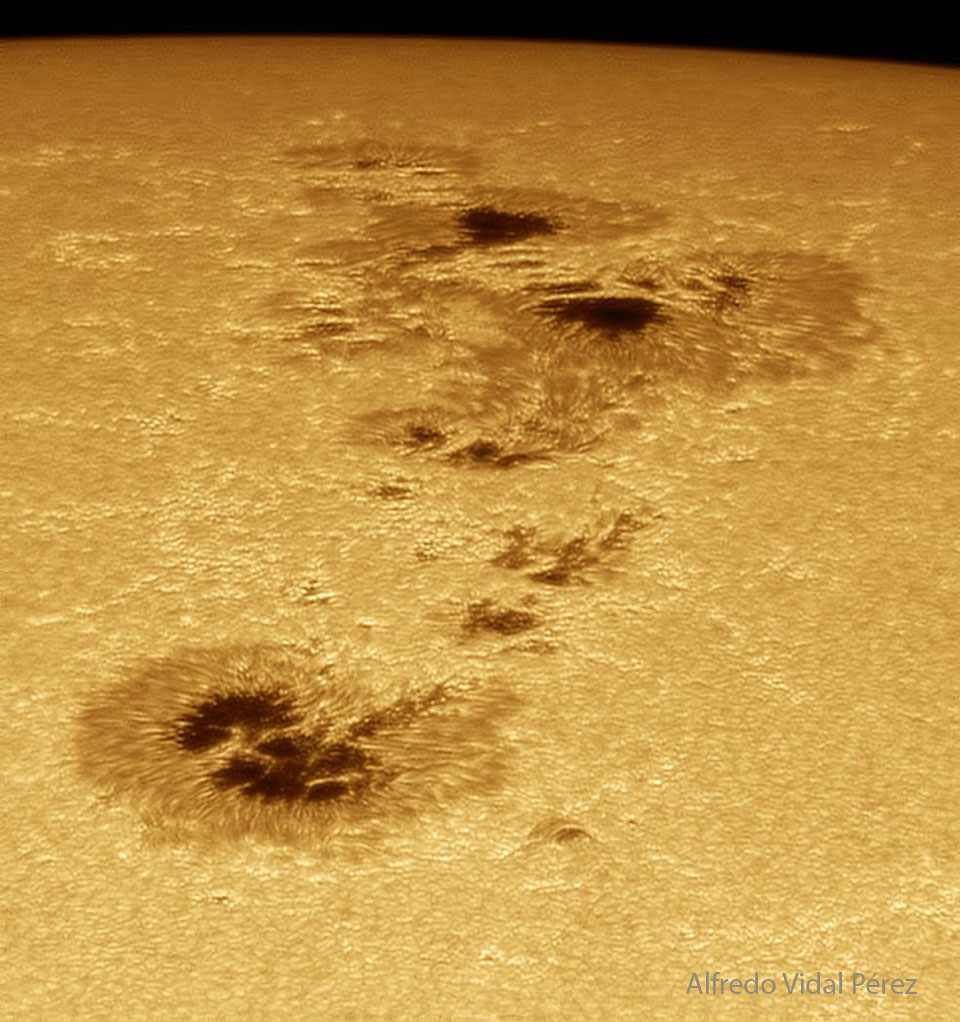
Credit: Not provided
Right now, one of the largest sunspot groups in recent history is crossing the Sun. Active Region 4478 is not only big -- it's violent, showing tangled magnetic fields capable of throwing off huge clouds of particles into the Solar System . Some of these CME s might impact the Earth. At the extreme, these solar storm s could cause some Earth-orbiting satellites to malfunction , the Earth's atmosphere to slightly distort, and electrical power grids to surge . When impacting Earth's upper atmosphere , these particles can produce beautiful auroras . Pictured here, AR 4478 and its dark sunspot s were captured in visible light a few days ago from Barcelona , Spain . Almost as large as AR 3664 was in 2024, the AR 4478 sunspot group is so big that it is visible just with glasses specially designed to view solar eclipse s. This week, skygazing enthusiasts all over the globe will not only be tracking AR 4478 during the day -- but keenly watching night skies for its corresponding bright auroras .
#APOD #SunSpot #SolarStorm #SolarPhysics #SpaceWeather #SolarObservation
https://apod.nasa.gov/apod/ap260628.html
原始 JSON
{
  "kind": 1,
  "id": "f102b331a16e80d211b8bc6e6cdc18753e7f3f500a1bdfc4586b11a69797fad6",
  "pubkey": "e85ed75286cb77475776c1007df8c4ff1c9c68eff91c3627347b065c5bf4dc78",
  "created_at": 1782619774,
  "tags": [],
  "content": "**Astronomy Picture of the Day**\n\n28 June 2026\n\n**AR 4478: Giant Sunspot Group**\n\nImage: https://apod.nasa.gov/apod/image/2606/AR4478_vidal_960.jpg\n\nCredit: Not provided\n\nRight now, one of the largest sunspot groups in recent history is crossing the Sun. Active Region 4478 is not only big -- it's violent, showing tangled magnetic fields capable of throwing off huge clouds of particles into the Solar System . Some of these CME s might impact the Earth. At the extreme, these solar storm s could cause some Earth-orbiting satellites to malfunction , the Earth's atmosphere to slightly distort, and electrical power grids to surge . When impacting Earth's upper atmosphere , these particles can produce beautiful auroras . Pictured here, AR 4478 and its dark sunspot s were captured in visible light a few days ago from Barcelona , Spain . Almost as large as AR 3664 was in 2024, the AR 4478 sunspot group is so big that it is visible just with glasses specially designed to view solar eclipse s. This week, skygazing enthusiasts all over the globe will not only be tracking AR 4478 during the day -- but keenly watching night skies for its corresponding bright auroras .\n\n#APOD #SunSpot #SolarStorm #SolarPhysics #SpaceWeather #SolarObservation\n\nhttps://apod.nasa.gov/apod/ap260628.html\n",
  "sig": "0f70622a50b7e10cb8befc5de970476b7b06965902d91a849adfc517e6a762dbc1a1109a1d607f5e81e447b8f9b193131465dd7aeda85952db3056fb1a575af2"
}