**Astronomy Picture of the Day**

npub1ap0dw55xedm5w4mkcyq8m7xyluwfc680lywrvfe50vr9ckl5m3uqtf5l75
hex
077e299c4f2a500fedf59444c216643c620031d4d354619f0dfe3719fe735f4bnevent
nevent1qqsqwl3fn38j55q0ah6eg3xzzejrccsqx82dx4rpnuxludcelee47jcprpmhxue69uhhyetvv9ujuem4d36kwatvw5hx6mm9qgswshkh22rvka682amvzqralrz078yudrhlj8pkyu68kpjut06dc7q8mjustKind-1 (TextNote)
Astronomy Picture of the Day
22 April 2026
Three Sky Arches over Snowy Alps
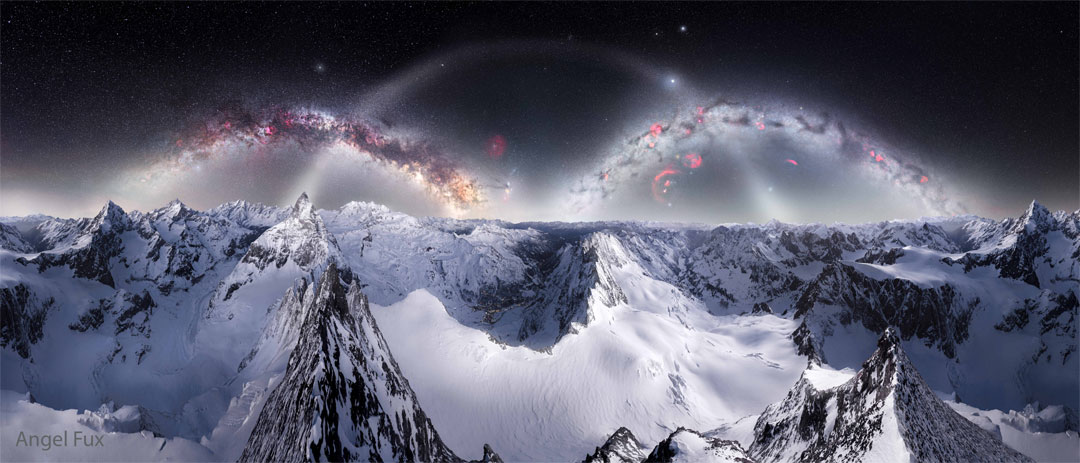
Image Credit: Angel Fux
Explanation:
Why are there three arches across the sky instead of two?
Last month, after being dropped off by a helicopter at a high mountain peak in the Alps near the Swiss Italian border, an adventurous astrophotographer expected two arches of our Milky Way galaxy to be visible during the night.
These were the inner arch looking in toward the center of our galaxy on the left, visible just before sunrise, and the outer arch on the right visible just after sunset.
But there were three arches.
The surprised astrophotographer soon realized that the sky was so dark that an entire arc of faint zodiacal light was also noticeable -- sunlight scattered by inner Solar System dust.
And it artfully connected the two Milky Way arches!
The next morning a helicopter picked the astrophotographer back up, and after 40 hours of processing and combining that night's images, the featured triple-arch 360-degree panorama resulted.
#APOD #Astronomy #AstronomyCommunity #SkyArch #ArchesOfTheSky #AtmosphericPhysics
https://apod.nasa.gov/apod/ap260421.html
Raw JSON
{
  "kind": 1,
  "id": "077e299c4f2a500fedf59444c216643c620031d4d354619f0dfe3719fe735f4b",
  "pubkey": "e85ed75286cb77475776c1007df8c4ff1c9c68eff91c3627347b065c5bf4dc78",
  "created_at": 1776831594,
  "tags": [],
  "content": "**Astronomy Picture of the Day**\n\n22 April 2026\n\n**Three Sky Arches over Snowy Alps**\n\nhttps://apod.nasa.gov/apod/image/2604/TripleArchAlps_Fux_1080.jpg\n\nImage Credit: Angel Fux\n\nExplanation:  \nWhy are there three arches across the sky instead of two?\n\nLast month, after being \ndropped off by a helicopter at a \nhigh mountain peak in the \nAlps near the \nSwiss \nItalian border, \nan adventurous astrophotographer expected two arches of \nour Milky Way galaxy to be \nvisible during the night.\n\nThese were the inner arch looking in \ntoward the center of our galaxy on the left, \nvisible just before sunrise, and the \nouter arch on the \nright visible just after sunset.  \n\nBut there were three arches.\n\nThe surprised \nastrophotographer soon realized that the sky was \nso dark that an \nentire arc of faint \nzodiacal light was also noticeable -- \nsunlight scattered by inner \nSolar System dust. \n\nAnd it artfully connected the two Milky Way arches! \n\nThe next morning a helicopter picked the astrophotographer back up, \nand after 40 hours of processing and combining that night's images, the \nfeatured triple-arch 360-degree panorama resulted.\n\n#APOD #Astronomy #AstronomyCommunity #SkyArch #ArchesOfTheSky #AtmosphericPhysics\n\nhttps://apod.nasa.gov/apod/ap260421.html\n",
  "sig": "e94a8ef95f2b629c39d351456e02fbd15340aa505a87bbecb850e60c4dcdcc5a178ed3c4958c658608e587fbee2a76075cb61db0cdfa1e6da0b30e3ad10e7ef2"
}