**Astronomy Picture of the Day**

npub1ap0dw55xedm5w4mkcyq8m7xyluwfc680lywrvfe50vr9ckl5m3uqtf5l75
hex
1f550b13bc9460971d270f4946c2ba70aac4f6997dea419330d60e8f246e4592nevent
nevent1qqsp74gtzw7fgcyhr5ns7j2xc2a8p2ky76vhm6jpjvcdvr50y3hytysprpmhxue69uhhyetvv9ujuem4d36kwatvw5hx6mm9qgswshkh22rvka682amvzqralrz078yudrhlj8pkyu68kpjut06dc7qcp2zsxKind-1 (TextNote)
Astronomy Picture of the Day
21 June 2026
Keogram: The Sky in 2025
Image: 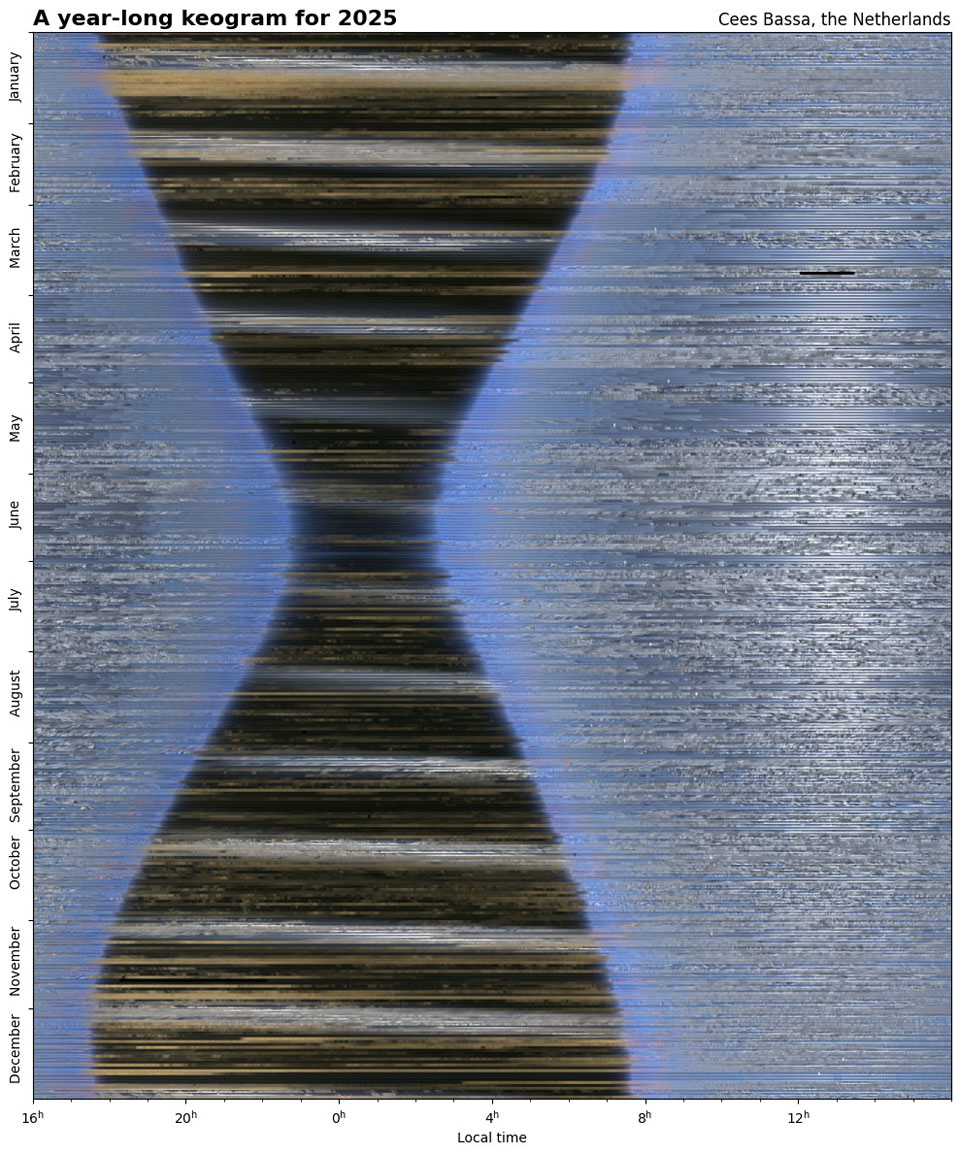
Credit: Not provided
What if you could see the entire sky -- all at once -- for an entire year? That, very nearly, is what is pictured here. Every 15 seconds during 2025, an all-sky camera took an image of the sky over the Netherlands . Central columns from these images were then aligned and combined to create the featured keogram , with January at the top, December at the bottom, and the middle of the night running vertically just left of center. What do we see? Most obviously, the daytime sky is mostly blue , while the nighttime sky is mostly black. The twelve light bands crossing the night sky are caused by the glow of the Moon . The thinnest part of the black hourglass shape occurs during the summer solstice , like today , when days are the longest, while the thickest part occurs at the winter solstice . Equinoxes can also be located in the keogram, for example the northern-spring equinox from one year ago is about three-quarters of the way up.
#APOD #Keogram #AllSkyCamera #NightSky #DaySky #MoonGlow
https://apod.nasa.gov/apod/ap260621.html
原始 JSON
{
  "kind": 1,
  "id": "1f550b13bc9460971d270f4946c2ba70aac4f6997dea419330d60e8f246e4592",
  "pubkey": "e85ed75286cb77475776c1007df8c4ff1c9c68eff91c3627347b065c5bf4dc78",
  "created_at": 1782014911,
  "tags": [],
  "content": "**Astronomy Picture of the Day**\n\n21 June 2026\n\n**Keogram: The Sky in 2025**\n\nImage: https://apod.nasa.gov/apod/image/2606/Keogram2025_Bassa_960.jpg\n\nCredit: Not provided\n\nWhat if you could see the entire sky -- all at once -- for an entire year? That, very nearly, is what is pictured here. Every 15 seconds during 2025, an all-sky camera took an image of the sky over the Netherlands . Central columns from these images were then aligned and combined to create the featured keogram , with January at the top, December at the bottom, and the middle of the night running vertically just left of center. What do we see? Most obviously, the daytime sky is mostly blue , while the nighttime sky is mostly black. The twelve light bands crossing the night sky are caused by the glow of the Moon . The thinnest part of the black hourglass shape occurs during the summer solstice , like today , when days are the longest, while the thickest part occurs at the winter solstice . Equinoxes can also be located in the keogram, for example the northern-spring equinox from one year ago is about three-quarters of the way up.\n\n#APOD #Keogram #AllSkyCamera #NightSky #DaySky #MoonGlow\n\nhttps://apod.nasa.gov/apod/ap260621.html\n",
  "sig": "7b6578deb8d4aa62e35882170675bcb79f032ebd3266c85113b5876aeedc08e9d1aac903f5a4b4c4751f90f79e5d5a861934cb7ad55c78ed935ea30976471005"
}