**Astronomy Picture of the Day**

npub1ap0dw55xedm5w4mkcyq8m7xyluwfc680lywrvfe50vr9ckl5m3uqtf5l75
hex
25950d97f9b08ec2316b9813e27cba1006060940ae59022dd14d2ef6faa214d2nevent
nevent1qqszt9gdjlumprkzx94esylz0japqpsxp9q2ukgz9hg56thkl23pf5sprpmhxue69uhhyetvv9ujuem4d36kwatvw5hx6mm9qgswshkh22rvka682amvzqralrz078yudrhlj8pkyu68kpjut06dc7qvjwk6rKind-1 (TextNote)
Astronomy Picture of the Day
03 April 2026
Caught in the Web: Visualization of a Black Hole Merger in the Tarantula Nebula
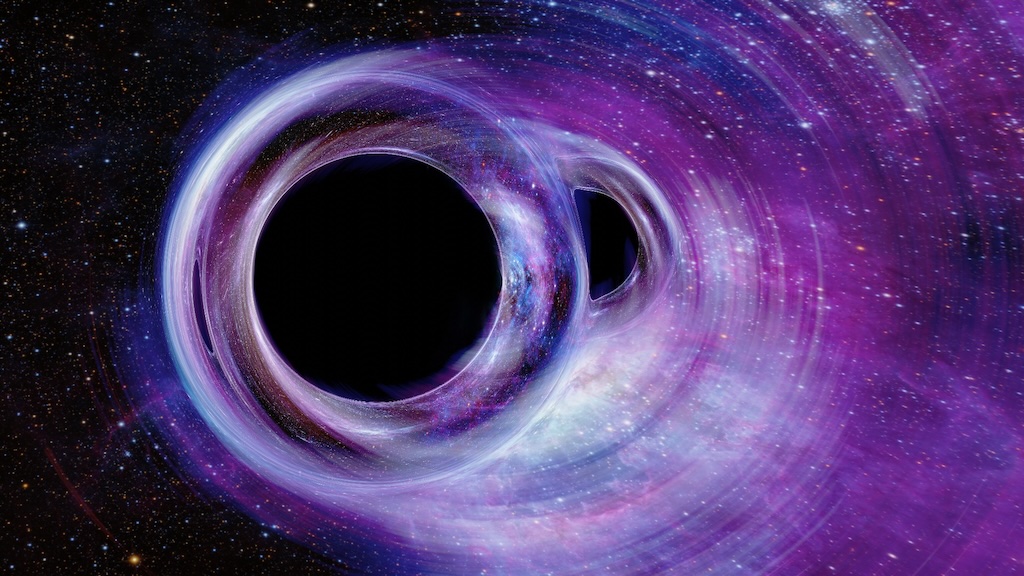
Image Credit: Carl Knox, OzGrav, Swinburne University of Technology, Blake Estes, Christian Sasse, iTelescope.net, Cecilia Chirenti, NASA, GSFC, CRESST II
Explanation:
How can we see what is invisible?
Black holes are not easy to see in the dark cosmic night, but astronomers can find them by analyzing their gravitational effects on matter, light and spacetime.
The featured image shows an illustration that combines a simulation of a black hole binary system in its final "death-dance" with an astrophotography image of the Tarantula Nebula in the background.
Even though black holes don't emit light, they distort the path of light rays, acting like a gravitational lens.
As a result, the nebula appears extremely distorted, forming Einstein rings and multiple images.
Tarantula Nebula lies in the Large Magellanic Cloud, a dwarf galaxy that is one of the satellite galaxies of the Milky Way, 160,000 light-years away.
That is more than 1,000 times closer than any of the binary black hole mergers detected so far.
We'll probably never detect a merger so close to home!
#APOD #BlackHoleMerger #TarantulaNebula #GravitationalWaves #Astrophysics #Cosmology
https://apod.nasa.gov/apod/ap260403.html
Raw JSON
{
  "kind": 1,
  "id": "25950d97f9b08ec2316b9813e27cba1006060940ae59022dd14d2ef6faa214d2",
  "pubkey": "e85ed75286cb77475776c1007df8c4ff1c9c68eff91c3627347b065c5bf4dc78",
  "created_at": 1775189559,
  "tags": [],
  "content": "**Astronomy Picture of the Day**\n\n03 April 2026\n\n**Caught in the Web: Visualization of a Black Hole Merger in the Tarantula Nebula**\n\nhttps://apod.nasa.gov/apod/image/2604/BH_Merger_Tarantula_1024.jpg\n\nImage Credit: Carl Knox, OzGrav, Swinburne University of Technology, Blake Estes, Christian Sasse, iTelescope.net, Cecilia Chirenti, NASA, GSFC, CRESST II\n\nExplanation:  \n\nHow can we see what is invisible?\n\nBlack holes are not easy to see in the dark cosmic night, but astronomers can find them by analyzing their gravitational effects on matter, light and spacetime.\n\nThe featured image shows an illustration that combines a simulation of a black hole binary system in its final \"death-dance\" with an astrophotography image of the Tarantula Nebula in the background.\n\nEven though black holes don't emit light, they distort the path of light rays, acting like a gravitational lens.\n\nAs a result, the nebula appears extremely distorted, forming Einstein rings and multiple images. \n\nTarantula Nebula lies in the Large Magellanic Cloud, a dwarf galaxy that is one of the satellite galaxies of the Milky Way, 160,000 light-years away.\n\nThat is more than 1,000 times closer than any of the binary black hole mergers detected so far.\n\nWe'll probably never detect a merger so close to home!\n\n#APOD #BlackHoleMerger #TarantulaNebula #GravitationalWaves #Astrophysics #Cosmology\n\nhttps://apod.nasa.gov/apod/ap260403.html\n",
  "sig": "00fd6a35fead842ce87cc5a2fc1be243151be806f08d947481272fb3d6b764c716180c29afff16199c22b0c995f3165ebfabbea8e0fcf53552cd5daf7a1f892f"
}