**Astronomy Picture of the Day**

npub1ap0dw55xedm5w4mkcyq8m7xyluwfc680lywrvfe50vr9ckl5m3uqtf5l75
hex
2844c5e4501805f28fe310734a4e62c7f0d26f0257f292e679886f903d1c4a8anevent
nevent1qqszs3x9u3gpsp0j3l33qu62fe3v0uxjdup90u5jueucsmus85wy4zsprpmhxue69uhhyetvv9ujuem4d36kwatvw5hx6mm9qgswshkh22rvka682amvzqralrz078yudrhlj8pkyu68kpjut06dc7qzgr9j5Kind-1 (TextNote)
Astronomy Picture of the Day
06 June 2026
Charon: Moon of Pluto
Image: 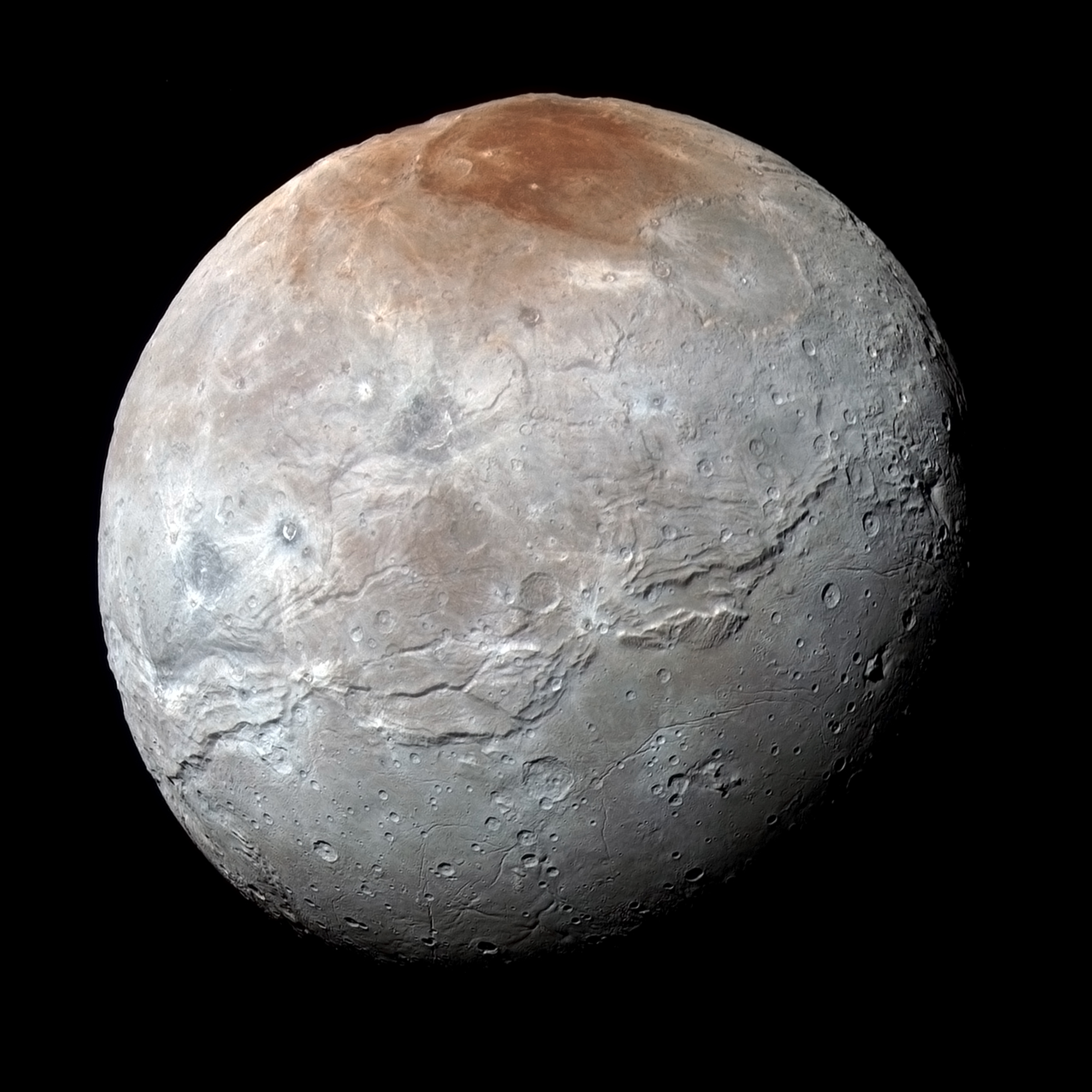
Image Credit: NASA , Johns Hopkins Univ./APL , Southwest Research Institute , U.S. Naval Observatory
A darkened and mysterious north polar region known to some as Mordor Macula caps this premier view of Charon, Pluto's largest moon . The high-resolution image was captured by the interplanetary space probe New Horizons near its closest approach to distant Pluto on July 14, 2015. The combined blue, red, and infrared image data was processed to enhance colors and follow variations in Charon's surface properties with a resolution of about 2.9 kilometers (1.8 miles). A stunning image of Charon's Pluto-facing hemisphere, it also features a clear view of an apparently moon-girdling belt of fractures and canyons that seems to separate smooth southern plains from varied northern terrain. Charon is 1,214 kilometers (754 miles) across. That's about 1/10th the size of planet Earth but a whopping 1/2 the diameter of Pluto itself , and makes it the largest satellite relative to its parent body in the Solar System. Still, the moon appears as a small bump at about the 1 o'clock position on Pluto's disk in the grainy, negative, telescopic picture inset at upper left. That image was used by James Christy and Robert Harrington at the U.S. Naval Observatory in Flagstaff to discover Charon in June of 1978 .
#APOD #Astroeducation #Astrophoto #lookUp #Universe
https://apod.nasa.gov/apod/ap260606.html
原始 JSON
{
  "kind": 1,
  "id": "2844c5e4501805f28fe310734a4e62c7f0d26f0257f292e679886f903d1c4a8a",
  "pubkey": "e85ed75286cb77475776c1007df8c4ff1c9c68eff91c3627347b065c5bf4dc78",
  "created_at": 1780718985,
  "tags": [],
  "content": "**Astronomy Picture of the Day**\n\n06 June 2026\n\n**Charon: Moon of Pluto**\n\nImage: https://apod.nasa.gov/apod/image/2606/Charon-Neutral-Bright-Release.jpg\n\nImage Credit: NASA , Johns Hopkins Univ./APL , Southwest Research Institute , U.S. Naval Observatory\n\nA darkened and mysterious north polar region known to some as Mordor Macula caps this premier view of Charon, Pluto's largest moon . The high-resolution image was captured by the interplanetary space probe New Horizons near its closest approach to distant Pluto on July 14, 2015. The combined blue, red, and infrared image data was processed to enhance colors and follow variations in Charon's surface properties with a resolution of about 2.9 kilometers (1.8 miles). A stunning image of Charon's Pluto-facing hemisphere, it also features a clear view of an apparently moon-girdling belt of fractures and canyons that seems to separate smooth southern plains from varied northern terrain. Charon is 1,214 kilometers (754 miles) across. That's about 1/10th the size of planet Earth but a whopping 1/2 the diameter of Pluto itself , and makes it the largest satellite relative to its parent body in the Solar System. Still, the moon appears as a small bump at about the 1 o'clock position on Pluto's disk in the grainy, negative, telescopic picture inset at upper left. That image was used by James Christy and Robert Harrington at the U.S. Naval Observatory in Flagstaff to discover Charon in June of 1978 .\n\n#APOD #Astroeducation #Astrophoto #lookUp #Universe\n\nhttps://apod.nasa.gov/apod/ap260606.html\n",
  "sig": "2f5ff2803e8f45920d5e796de5aef0ad7cceeaeb9cbce769ea82edae8bd0445c6d6006ae9f15ed1dfa4690414d64e89ff1eb5e4a94698f06a442d47f693bd406"
}