**Astronomy Picture of the Day**

npub1ap0dw55xedm5w4mkcyq8m7xyluwfc680lywrvfe50vr9ckl5m3uqtf5l75
hex
3ba77316c74ec08dff3b247a92ae9b068a3b7a289d5c5413e95fccc26f54af00nevent
nevent1qqsrhfmnzmr5asydluajg75j46dsdz3m0g5f6hz5z054lnxzda227qqprpmhxue69uhhyetvv9ujuem4d36kwatvw5hx6mm9qgswshkh22rvka682amvzqralrz078yudrhlj8pkyu68kpjut06dc7q8vvml3Kind-1 (TextNote)
Astronomy Picture of the Day
29 June 2026
M82: Galaxy with a Supergalactic Wind
Image: 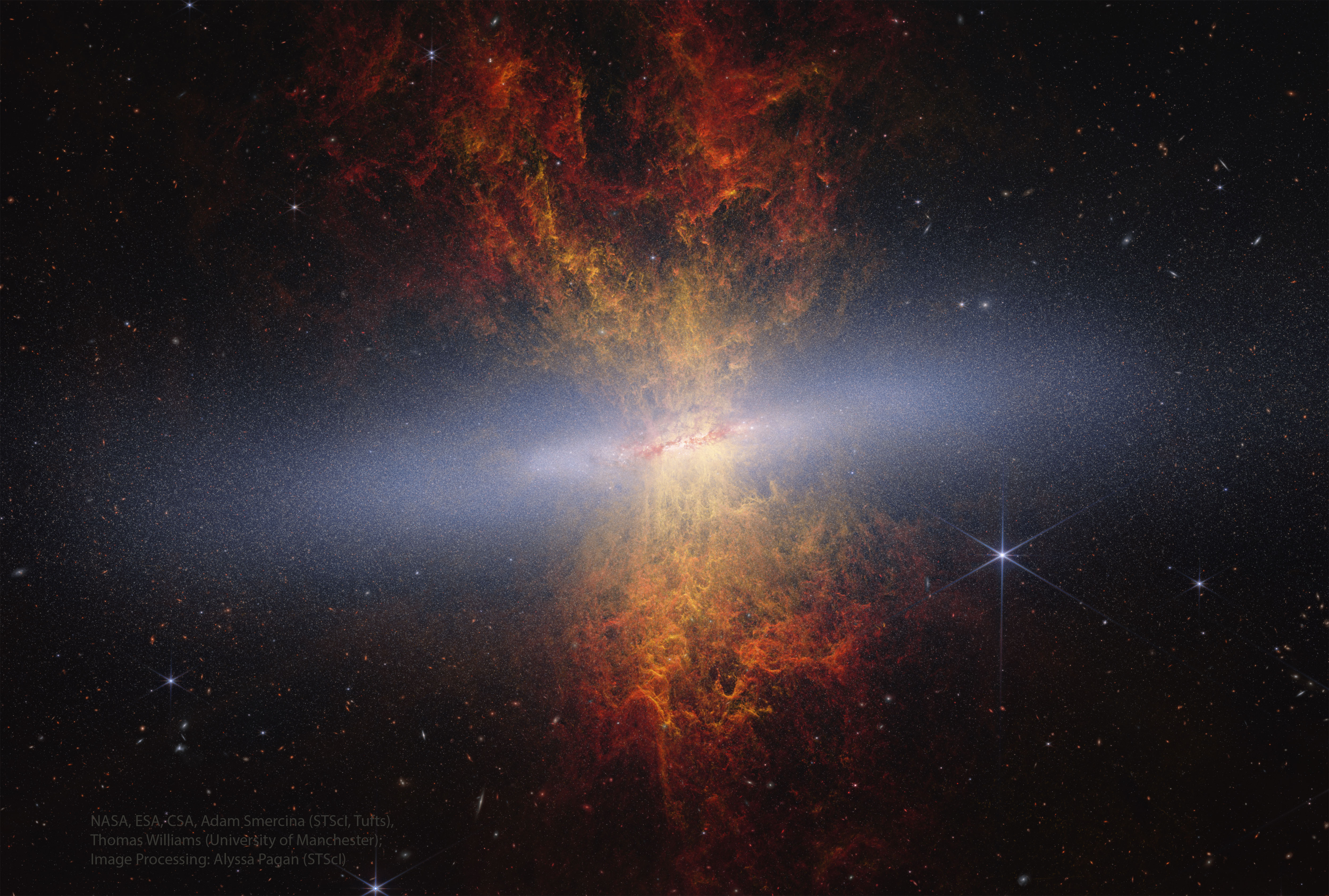
Image Credit: NASA , ESA , CSA , A. Smercina (STScI, Tufts), T. Williams (U. Manchester); Image Processing: A. Pagan (STScI)
Why is the Cigar Galaxy billowing red smoke? M82 , as this starburst galaxy is also known, was stirred up by a recent pass near large spiral galaxy M81 . This doesn't fully explain the source of the red-glowing outwardly expanding gas and dust, however. Evidence indicates that this gas and dust is being driven out by the combined emerging particle winds of many stars, together creating a galactic superwind . The dust particles are thought to originate in M82's interstellar medium and are actually similar in size to particles in cigar smoke. The featured photographic mosaic combines images taken in visible light from the Hubble Space Telescope and images taken in infrared light from James Webb Space Telescope . It shows the light-colored central galaxy nearly edge on across the image center with tremendous orange and red colored filaments of gas and dust extending both up and down. The filaments extend for over 10,000 light year s. The 12-million light-year distant Cigar Galaxy is the brightest galaxy in the sky in infrared light and can be seen in visible light with a small telescope towards the constellation of the Great Bear ( Ursa Major ).
#APOD #M82 #CigarGalaxy #SupergalacticWind #StarburstGalaxy #M81
https://apod.nasa.gov/apod/ap260629.html
原始 JSON
{
  "kind": 1,
  "id": "3ba77316c74ec08dff3b247a92ae9b068a3b7a289d5c5413e95fccc26f54af00",
  "pubkey": "e85ed75286cb77475776c1007df8c4ff1c9c68eff91c3627347b065c5bf4dc78",
  "created_at": 1782706198,
  "tags": [],
  "content": "**Astronomy Picture of the Day**\n\n29 June 2026\n\n**M82: Galaxy with a Supergalactic Wind**\n\nImage: https://apod.nasa.gov/apod/image/2606/M82_HubbleWebb_5000.jpg\n\nImage Credit: NASA , ESA , CSA , A. Smercina (STScI, Tufts), T. Williams (U. Manchester); Image Processing: A. Pagan (STScI)\n\nWhy is the Cigar Galaxy billowing red smoke? M82 , as this starburst galaxy is also known, was stirred up by a recent pass near large spiral galaxy M81 . This doesn't fully explain the source of the red-glowing outwardly expanding gas and dust, however. Evidence indicates that this gas and dust is being driven out by the combined emerging particle winds of many stars, together creating a galactic superwind . The dust particles are thought to originate in M82's interstellar medium and are actually similar in size to particles in cigar smoke. The featured photographic mosaic combines images taken in visible light from the Hubble Space Telescope and images taken in infrared light from James Webb Space Telescope . It shows the light-colored central galaxy nearly edge on across the image center with tremendous orange and red colored filaments of gas and dust extending both up and down. The filaments extend for over 10,000 light year s. The 12-million light-year distant Cigar Galaxy is the brightest galaxy in the sky in infrared light and can be seen in visible light with a small telescope towards the constellation of the Great Bear ( Ursa Major ).\n\n#APOD #M82 #CigarGalaxy #SupergalacticWind #StarburstGalaxy #M81\n\nhttps://apod.nasa.gov/apod/ap260629.html\n",
  "sig": "4cc993dd1ea9a28e0a648aef81d9ba4027e3f9e971efa5ff9708bc994fb44885e3beb961c6c9c268a8b818c97ca3c788114b4af27b7af1187c1268a2bef2a2fb"
}