**Astronomy Picture of the Day**

npub1ap0dw55xedm5w4mkcyq8m7xyluwfc680lywrvfe50vr9ckl5m3uqtf5l75
hex
41c6d5ad3b591334c04b09d7d8af60a5597735400643e7ba69f3448c2cc0446anevent
nevent1qqsyr3k445a4jye5cp9sn47c4as22kthx4qqvsl8hf5lx3yv9nqyg6sprpmhxue69uhhyetvv9ujuem4d36kwatvw5hx6mm9qgswshkh22rvka682amvzqralrz078yudrhlj8pkyu68kpjut06dc7q5mu035Kind-1 (TextNote)
Astronomy Picture of the Day
05 June 2026
The Hydra Cluster of Galaxies
Image: 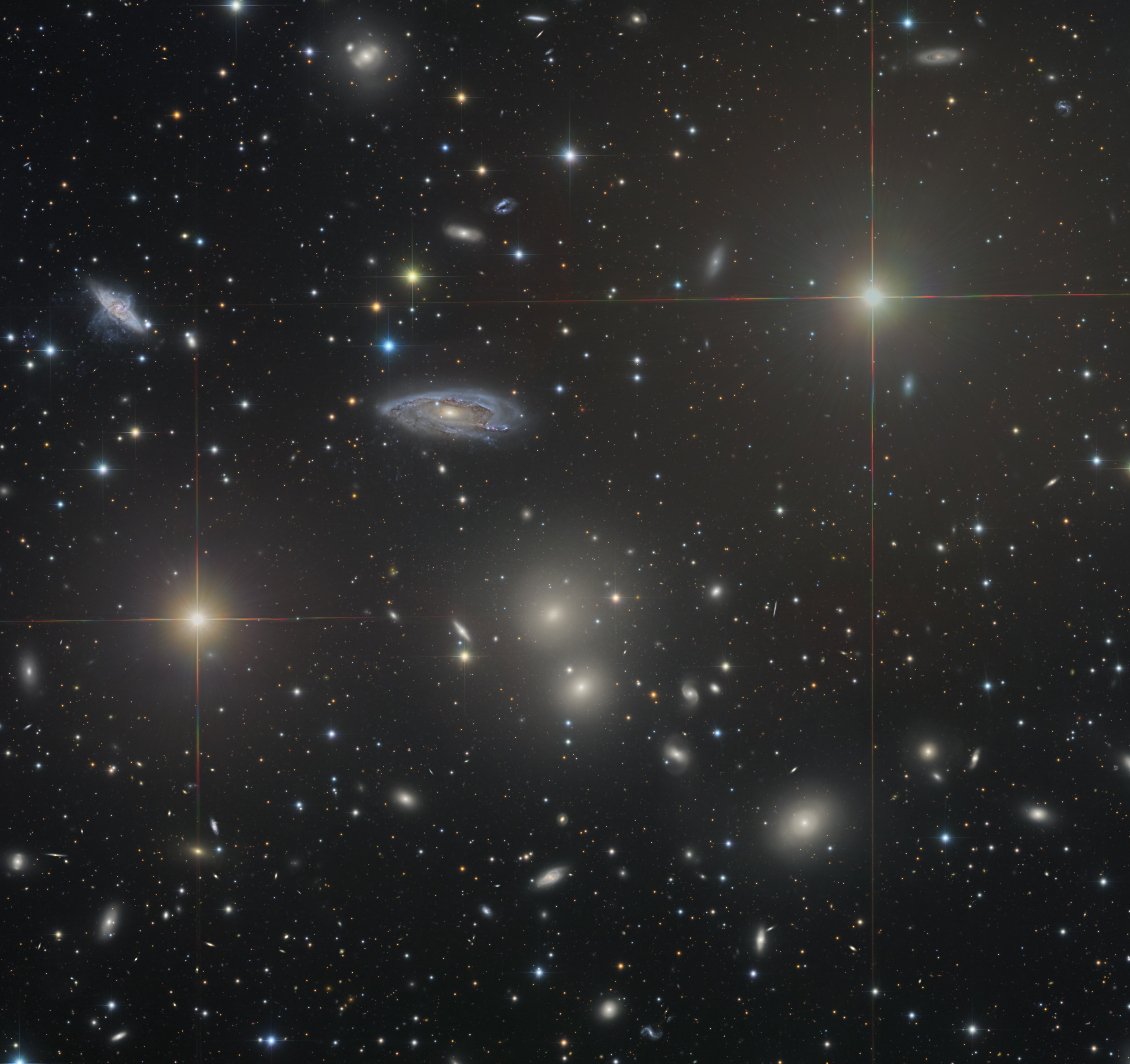
Credit: Not provided
Within our own Milky Way galaxy, two bright, spiky stars stand like sentinels in the foreground of this cosmic snapshot . Far beyond them are the galaxies of the Hydra Cluster . In fact, while the spiky foreground stars are hundreds of light-years distant, the Hydra Cluster galaxies are well over 100 million light-years away. Three large galaxies near the cluster center, two yellow ellipticals (NGC 3311, NGC 3309) and one prominent blue spiral (NGC 3312), are the dominant galaxies, each about 150,000 light-years in diameter. An intriguing overlapping galaxy pair cataloged as NGC 3314 lies above and left of NGC 3312. Also known as Abell 1060, the Hydra galaxy cluster is one of three large galaxy clusters within 200 million light-years of the Milky Way. In the nearby universe , galaxies are gravitationally bound into clusters which themselves are loosely bound into superclusters . Superclusters in turn are seen to align over even larger scales .
#APOD #Astrophotography #Universe #Astronomy #Astrogeek
https://apod.nasa.gov/apod/ap260605.html
原始 JSON
{
  "kind": 1,
  "id": "41c6d5ad3b591334c04b09d7d8af60a5597735400643e7ba69f3448c2cc0446a",
  "pubkey": "e85ed75286cb77475776c1007df8c4ff1c9c68eff91c3627347b065c5bf4dc78",
  "created_at": 1780632591,
  "tags": [],
  "content": "**Astronomy Picture of the Day**\n\n05 June 2026\n\n**The Hydra Cluster of Galaxies**\n\nImage: https://apod.nasa.gov/apod/image/2606/HydraClusterSampaio.jpg\n\nCredit: Not provided\n\nWithin our own Milky Way galaxy, two bright, spiky stars stand like sentinels in the foreground of this cosmic snapshot . Far beyond them are the galaxies of the Hydra Cluster . In fact, while the spiky foreground stars are hundreds of light-years distant, the Hydra Cluster galaxies are well over 100 million light-years away. Three large galaxies near the cluster center, two yellow ellipticals (NGC 3311, NGC 3309) and one prominent blue spiral (NGC 3312), are the dominant galaxies, each about 150,000 light-years in diameter. An intriguing overlapping galaxy pair cataloged as NGC 3314 lies above and left of NGC 3312. Also known as Abell 1060, the Hydra galaxy cluster is one of three large galaxy clusters within 200 million light-years of the Milky Way. In the nearby universe , galaxies are gravitationally bound into clusters which themselves are loosely bound into superclusters . Superclusters in turn are seen to align over even larger scales .\n\n#APOD #Astrophotography #Universe #Astronomy #Astrogeek\n\nhttps://apod.nasa.gov/apod/ap260605.html\n",
  "sig": "f158d93d5d28eb08d4f7581c2b3ce4ace7e95334c1b0ca626307053d0bd42cdc7ada508e2b8e5935b9ffe15450d9c80c559405830468eaeae6fad3477f28d5fd"
}