**Astronomy Picture of the Day**

npub1ap0dw55xedm5w4mkcyq8m7xyluwfc680lywrvfe50vr9ckl5m3uqtf5l75
hex
45c7762d93ff464340eaaf4ee46f3695cdfbd0ef129a258f4e1f907e6632d1e0nevent
nevent1qqsyt3mk9kfl73jrgr427nhydumftn0m6rh39x393a8plyr7vcedrcqprpmhxue69uhhyetvv9ujuem4d36kwatvw5hx6mm9qgswshkh22rvka682amvzqralrz078yudrhlj8pkyu68kpjut06dc7qvgr5jkKind-1 (TextNote)
Astronomy Picture of the Day
11 April 2026
Exploring the Antennae
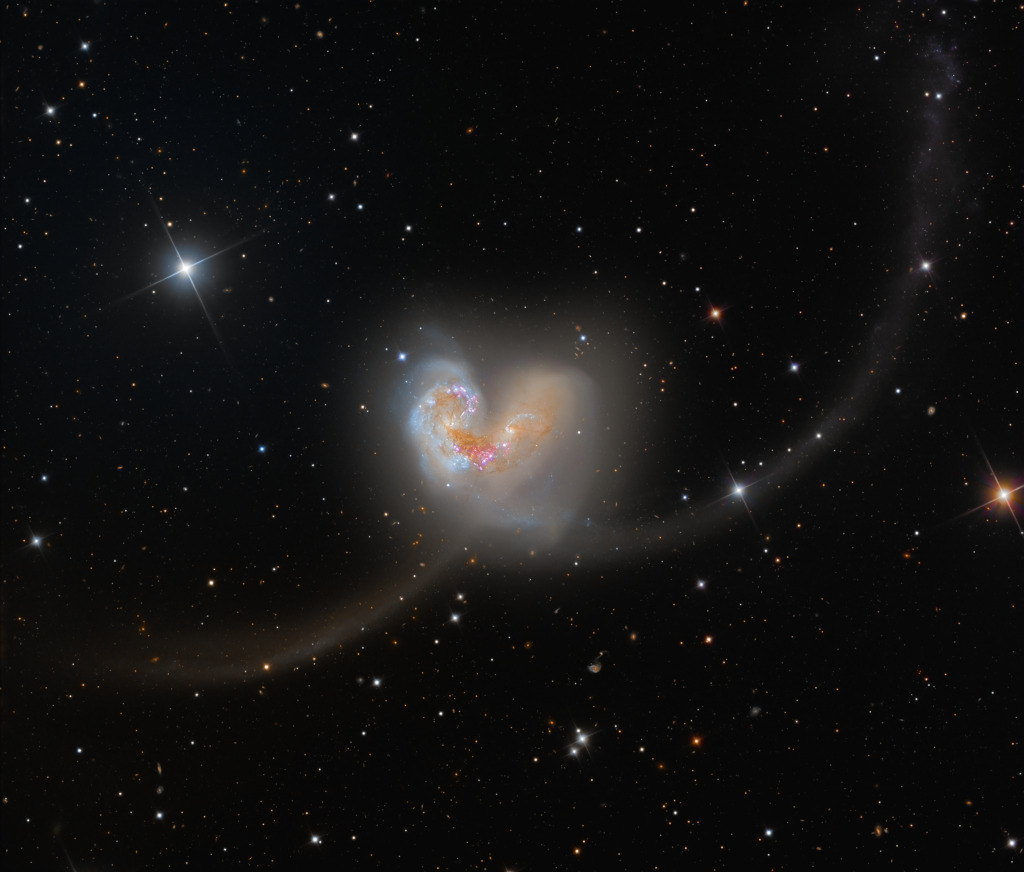
Image Credit: Mike Selby, Roberto Colombari
Explanation:
Some 60 million light-years away in the southerly constellation Corvus, two large galaxies are colliding.
Stars in the two galaxies, cataloged as NGC 4038 and NGC 4039, very rarely collide in the course of the ponderous cataclysm that lasts for hundreds of millions of years.
But the galaxies' large clouds of molecular gas and dust often do, triggering furious episodes of star formation near the center of the cosmic wreckage.
Spanning over 50 thousand light-years, this stunning telescopic frame also reveals new star clusters and matter flung far from the scene of the accident by gravitational tidal forces.
The remarkably sharp ground-based image follows the faint tidal tails and distant background galaxies in the field of view.
The suggestive overall visual appearance of the extended arcing structures gives the galaxy pair, also known as Arp 244, its popular name - The Antennae.
#APOD #AntennaeGalaxies #NGC4038 #NGC4039 #GalaxyCollision #StarFormation
https://apod.nasa.gov/apod/ap260410.html
Raw JSON
{
  "kind": 1,
  "id": "45c7762d93ff464340eaaf4ee46f3695cdfbd0ef129a258f4e1f907e6632d1e0",
  "pubkey": "e85ed75286cb77475776c1007df8c4ff1c9c68eff91c3627347b065c5bf4dc78",
  "created_at": 1775881376,
  "tags": [],
  "content": "**Astronomy Picture of the Day**\n\n11 April 2026\n\n**Exploring the Antennae**\n\nhttps://apod.nasa.gov/apod/image/2604/n4038_n4039_antennaeSelbyColombari1024.jpg\n\nImage Credit: Mike Selby, Roberto Colombari\n\nExplanation:  \n\nSome 60 million light-years away in the southerly\nconstellation\nCorvus, two large galaxies are colliding.\n\nStars in the two galaxies, cataloged as\nNGC 4038 and\nNGC 4039,\nvery rarely collide in the course of the\nponderous cataclysm that lasts for hundreds of millions of years.\n\nBut the galaxies' large\nclouds of molecular gas and dust\noften do, triggering\nfurious episodes of star formation\nnear the center of the\ncosmic wreckage.\n\nSpanning over 50 thousand light-years, this\nstunning telescopic frame also reveals new star clusters and\nmatter flung far from the scene of the accident by\ngravitational tidal\nforces.\n\nThe remarkably\nsharp ground-based image \nfollows the faint tidal tails and distant background galaxies in the\nfield of view.\n\nThe suggestive overall visual appearance of the extended arcing\nstructures gives the galaxy pair, also known as Arp 244,\nits popular name -\nThe Antennae.\n\n#APOD #AntennaeGalaxies #NGC4038 #NGC4039 #GalaxyCollision #StarFormation\n\nhttps://apod.nasa.gov/apod/ap260410.html\n",
  "sig": "1294bc7008629a1922c3dd2aa97c48ac1be282663d6b886332e028447f6292d133abb1fdfeedbb36bca3996d8c71a377a2c31faae22b41f98eebf89afc9e7e4b"
}