**Astronomy Picture of the Day**

npub1ap0dw55xedm5w4mkcyq8m7xyluwfc680lywrvfe50vr9ckl5m3uqtf5l75
hex
4b773bf8328f7230e62435680a6bdaa48fea0862e0bfc4e0edfe06f557b368a3nevent
nevent1qqsykaemlqeg7u3sucjr26q2d0d2frl2pp3wp07yurkluph427ek3gcprpmhxue69uhhyetvv9ujuem4d36kwatvw5hx6mm9qgswshkh22rvka682amvzqralrz078yudrhlj8pkyu68kpjut06dc7qxkhttrKind-1 (TextNote)
Astronomy Picture of the Day
19 April 2026
PanSTARRS and Planets
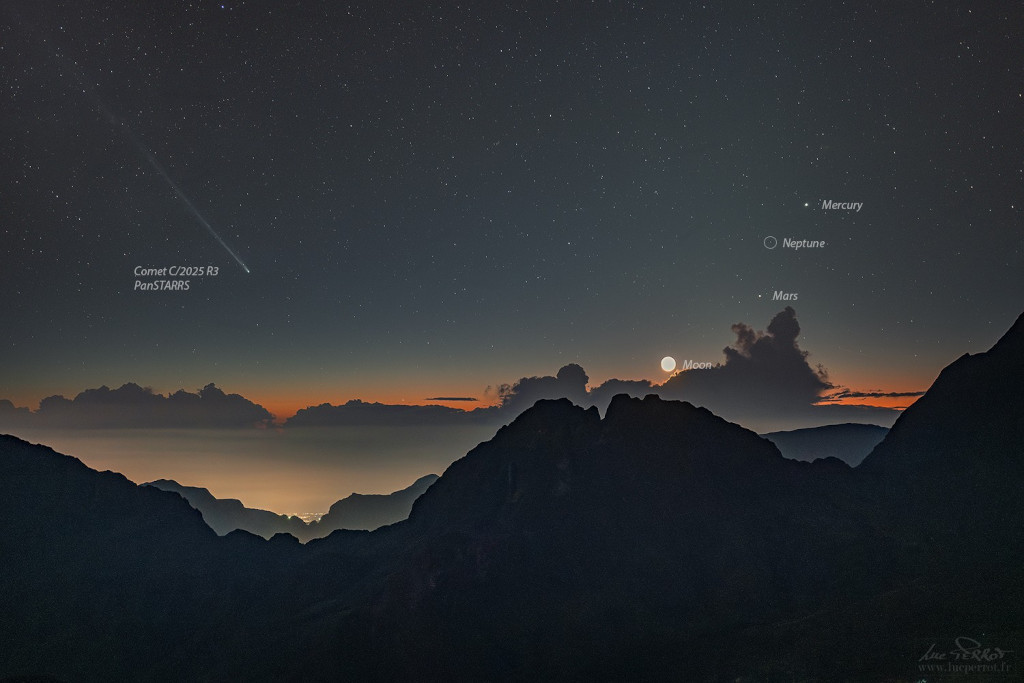
Image Credit: Luc Perrot, TWAN
Explanation:
Near the eastern horizon before sunrise, Comet C/2025 R3 PanSTARRS is getting brighter.
Readily visible in binoculars and small telescopes, the comet may be just on the verge of naked-eye visibility from dark sky sites.
Though it was not quite apparent to the eye, PanSTARRS is still easy to spot in this camera image taken on April 16.
In the view from a volcanic peak overlooking France's Reunion Island, planet Earth, the comet shares eastern predawn skies with naked-eye planets Mars and Mercury and fainter Neptune.
Saturn is hiding behind the low cloudbank that doesn't quite hide an old crescent Moon.
This is a good weekend for northern hemisphere comet watchers to try to catch PanSTARRS an hour or so before sunrise, as the comet grows brighter approaching its perihelion on April 19.
On April 26 the comet makes its closest approach to our fair planet but by then will be difficult to see in the solar glare.
Good views of this comet PanSTARRS in late April and early May will be from the southern hemisphere.
#APOD #PanSTARRS #CometC2025R3 #CometWatch #CelestialEvents #NightSky
https://apod.nasa.gov/apod/ap260418.html
Raw JSON
{
  "kind": 1,
  "id": "4b773bf8328f7230e62435680a6bdaa48fea0862e0bfc4e0edfe06f557b368a3",
  "pubkey": "e85ed75286cb77475776c1007df8c4ff1c9c68eff91c3627347b065c5bf4dc78",
  "created_at": 1776571890,
  "tags": [],
  "content": "**Astronomy Picture of the Day**\n\n19 April 2026\n\n**PanSTARRS and Planets**\n\nhttps://apod.nasa.gov/apod/image/2604/PanstarrsPlanetsPerrotLab1024.jpg\n\nImage Credit: Luc Perrot, TWAN\n\nExplanation:  \n\nNear the eastern horizon before sunrise, Comet C/2025 R3\nPanSTARRS is getting brighter.\n\nReadily visible in binoculars and small telescopes,\nthe comet may be just on the verge of naked-eye visibility \nfrom dark sky sites.\n\nThough it was not quite apparent to the eye,\nPanSTARRS\nis still easy to spot in this camera image taken on April 16.\n\nIn the view\nfrom a volcanic peak overlooking France's Reunion Island, planet Earth,\nthe comet shares eastern predawn skies with\nnaked-eye planets Mars and Mercury\nand fainter Neptune.\n\nSaturn is hiding behind the low cloudbank that doesn't quite hide\nan old crescent Moon.\n\nThis is a good weekend\nfor northern hemisphere comet watchers to try to\ncatch PanSTARRS\nan hour or so before sunrise,\nas the comet grows brighter approaching its perihelion on\nApril 19.\n\nOn April 26 the comet makes its closest approach to our fair planet\nbut by then will be difficult to see in the solar glare.\n\nGood views\nof this comet PanSTARRS in late April and early May will be from\nthe southern hemisphere.\n\n#APOD #PanSTARRS #CometC2025R3 #CometWatch #CelestialEvents #NightSky\n\nhttps://apod.nasa.gov/apod/ap260418.html\n",
  "sig": "ce73b495796a4e32f3dbb9fa1c6e836f1b9c95927a30003ebe4f123bdcd877046a47c10f5912ff1bd3f56e038e858dc203b439df899cfb3b83f17b2b351fbc94"
}