**Astronomy Picture of the Day**

npub1ap0dw55xedm5w4mkcyq8m7xyluwfc680lywrvfe50vr9ckl5m3uqtf5l75
hex
66078de0df5199c78f96c294d05cd8616ae9ce69450075a55f85240eac464331nevent
nevent1qqsxvpudur04rxw837tv99xstnvxz6hfee552qr4540c2fqw43ryxvgprpmhxue69uhhyetvv9ujuem4d36kwatvw5hx6mm9qgswshkh22rvka682amvzqralrz078yudrhlj8pkyu68kpjut06dc7qquaqsqKind-1 (TextNote)
Astronomy Picture of the Day
18 June 2026
Possible Supernova Remnant in Galactic Center
Image: 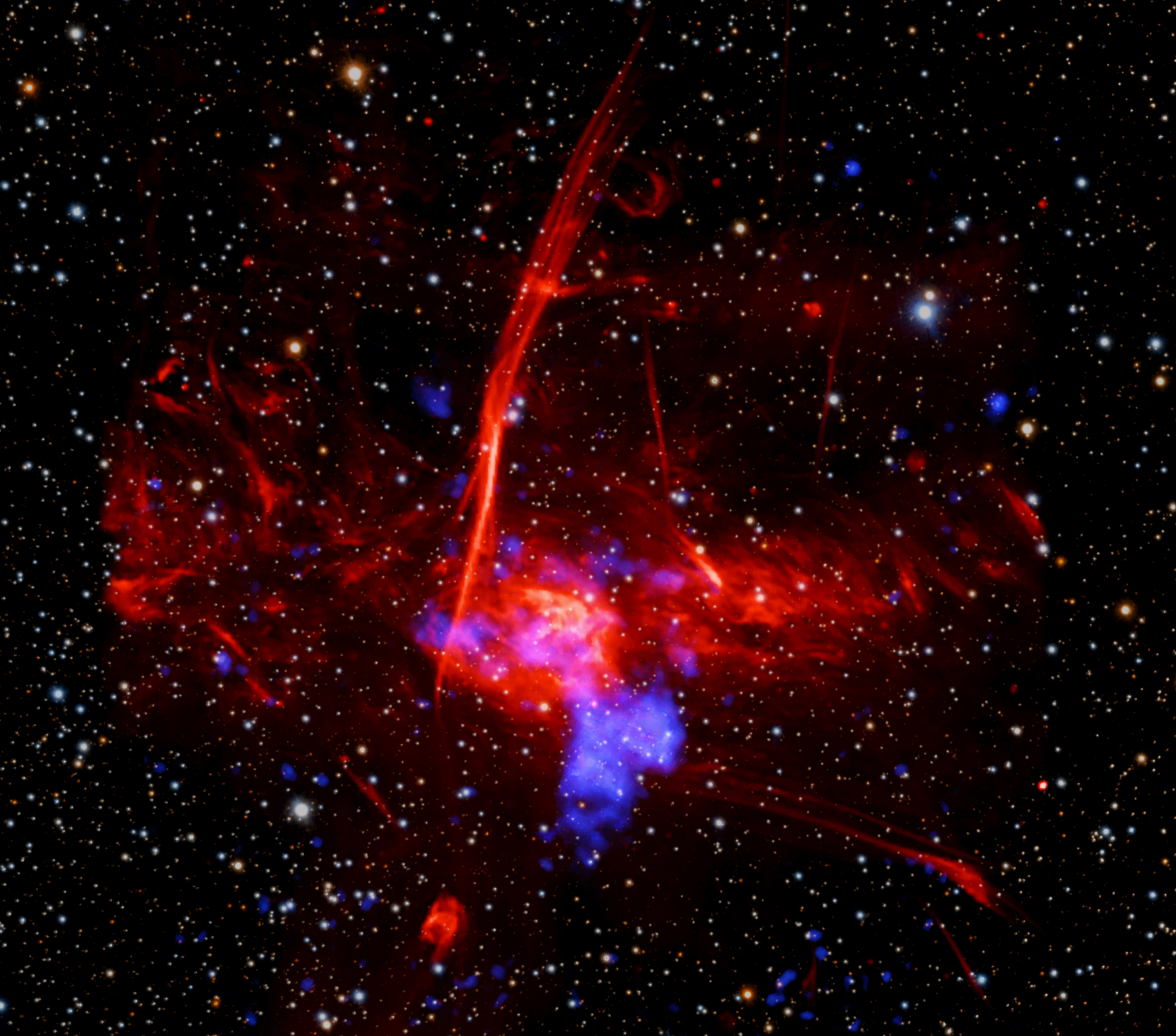
Credit: Not provided
Do you see that blue blob to the lower right of the image center? Astronomers think that it shows where a massive star exploded as a supernova whose light reached Earth 1,700 years ago . The image combines optical data from the PanSTARRS telescopes in Hawaii (background stars in red, green, and blue), radio from the MeerKAT telescope in South Africa (large red cloud) and X-rays from NASA 's Chandra X-ray Observatory and ESA ’s XMM-Newton (shown in blue). The large cloud is a star forming region called Sagittarius C , which is approximately 50 light-years in extent and about 26,000 light-years from Earth . It is located only about 260 light-years from the supermassive black hole in the center of the Galaxy (off to the left of the image). If the blue blob is confirmed to be a supernova remnant , it would be one of the closest ever discovered to the Galactic Center . In this dense region , the deaths of massive stars are connected to the birth of new stars through gas and magnetic fields in a complex way.
#APOD #Supernova #SupernovaRemnant #SagittariusC #MilkyWay #GalacticCenter
https://apod.nasa.gov/apod/ap260618.html
原始 JSON
{
  "kind": 1,
  "id": "66078de0df5199c78f96c294d05cd8616ae9ce69450075a55f85240eac464331",
  "pubkey": "e85ed75286cb77475776c1007df8c4ff1c9c68eff91c3627347b065c5bf4dc78",
  "created_at": 1781755600,
  "tags": [],
  "content": "**Astronomy Picture of the Day**\n\n18 June 2026\n\n**Possible Supernova Remnant in Galactic Center**\n\nImage: https://apod.nasa.gov/apod/image/2606/sgrc_lg.jpg\n\nCredit: Not provided\n\nDo you see that blue blob to the lower right of the image center? Astronomers think that it shows where a massive star exploded as a supernova whose light reached Earth 1,700 years ago . The image combines optical data from the PanSTARRS telescopes in Hawaii (background stars in red, green, and blue), radio from the MeerKAT telescope in South Africa (large red cloud) and X-rays from NASA 's Chandra X-ray Observatory and ESA ’s XMM-Newton (shown in blue). The large cloud is a star forming region called Sagittarius C , which is approximately 50 light-years in extent and about 26,000 light-years from Earth . It is located only about 260 light-years from the supermassive black hole in the center of the Galaxy (off to the left of the image). If the blue blob is confirmed to be a supernova remnant , it would be one of the closest ever discovered to the Galactic Center . In this dense region , the deaths of massive stars are connected to the birth of new stars through gas and magnetic fields in a complex way.\n\n#APOD #Supernova #SupernovaRemnant #SagittariusC #MilkyWay #GalacticCenter\n\nhttps://apod.nasa.gov/apod/ap260618.html\n",
  "sig": "42097e49680a0bb0aa49c144d3489e47175cedbee9d902ab3c099878c3bf01afeeca918046cb8d88190c6f0a8839c11af08d133fd652a8b57418d6634c82e40f"
}