**Astronomy Picture of the Day**

npub1ap0dw55xedm5w4mkcyq8m7xyluwfc680lywrvfe50vr9ckl5m3uqtf5l75
hex
68198707ba3ec8bf80471cdfa68a554febe7b3d05e87eb7d3606bfe962bd0b6dnevent
nevent1qqsxsxv8q7araj9lspr3ehax3f25l6l8k0g9aplt05mqd0lfv27skmgprpmhxue69uhhyetvv9ujuem4d36kwatvw5hx6mm9qgswshkh22rvka682amvzqralrz078yudrhlj8pkyu68kpjut06dc7q35zc2dKind-1 (TextNote)
Astronomy Picture of the Day
28 March 2026
Hickson 44 in Leo
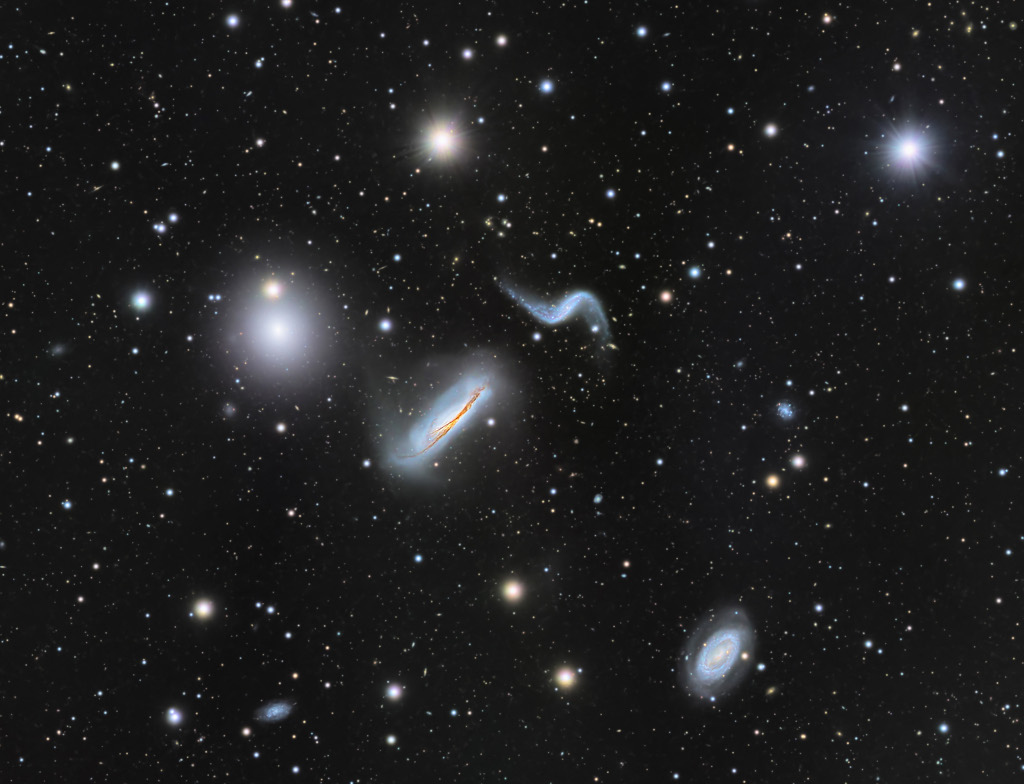
Image Credit: Peter Kennett
Explanation:
Scanning the skies for galaxies, Canadian astronomer Paul Hickson and colleagues identified some 100 compact groups of galaxies, now appropriately called Hickson Compact Groups.
The four prominent galaxies seen in this intriguing telescopic skyscape are one such group, Hickson 44.
The Hickson 44 galaxy group is about 100 million light-years distant, far beyond the foreground Milky Way stars, toward the northern springtime constellation Leo.
The two spiral galaxies in the center of the image are edge-on NGC 3190 with distinctive, warped dust lanes, and S-shaped NGC 3187.
Along with the bright elliptical, NGC 3193 (left) they are also known as Arp 316.
The spiral toward the lower right corner is NGC 3185, the 4th member of the Hickson group.
Like other galaxies in Hickson groups, these show signs of distortion and enhanced star formation, evidence of a gravitational tug of war that will eventually result in galaxy mergers on a cosmic timescale.
The merger process is now understood to be a normal part of the evolution of galaxies, including our own Milky Way.
For scale, NGC 3190 is about 75,000 light-years across at the estimated distance of Hickson 44.
#APOD #Hickson44 #CompactGroups #Leo #NGC3190 #NGC3187
https://apod.nasa.gov/apod/ap260327.html
Raw JSON
{
  "kind": 1,
  "id": "68198707ba3ec8bf80471cdfa68a554febe7b3d05e87eb7d3606bfe962bd0b6d",
  "pubkey": "e85ed75286cb77475776c1007df8c4ff1c9c68eff91c3627347b065c5bf4dc78",
  "created_at": 1774671582,
  "tags": [],
  "content": "**Astronomy Picture of the Day**\n\n28 March 2026\n\n**Hickson 44 in Leo**\n\nhttps://apod.nasa.gov/apod/image/2603/NGC3190-APOD1024.jpg\n\nImage Credit: Peter Kennett\n\nExplanation:  \n\nScanning the skies for galaxies, Canadian astronomer\nPaul Hickson and colleagues identified some 100 compact\ngroups of galaxies,\nnow appropriately called\nHickson Compact Groups.\n\nThe four prominent galaxies seen in this intriguing\ntelescopic skyscape\nare one such group, Hickson 44.\n\nThe Hickson 44 galaxy group is about 100 million light-years distant,\nfar beyond the foreground Milky Way stars,\ntoward the northern springtime constellation Leo.\n\nThe two spiral galaxies\nin the center of the image are edge-on NGC 3190 with distinctive,\nwarped dust lanes, and S-shaped NGC 3187.\n\nAlong with the bright elliptical, NGC 3193 (left)\nthey are also known as Arp 316.\n\nThe spiral toward the lower right corner is NGC 3185,\nthe 4th member of the Hickson group.\n\nLike other galaxies in\nHickson groups,\nthese show signs of distortion and\nenhanced star formation,\nevidence of a gravitational tug of war that will eventually result in\ngalaxy mergers on a cosmic timescale.\n\nThe merger process is\nnow understood to be a normal part of the evolution of\ngalaxies, including our own Milky Way.\n\nFor scale, NGC 3190\nis about 75,000 light-years across at the estimated\ndistance of Hickson 44.\n\n#APOD #Hickson44 #CompactGroups #Leo #NGC3190 #NGC3187\n\nhttps://apod.nasa.gov/apod/ap260327.html\n",
  "sig": "59c73af2b6cf845e325cf7b7fd23c343b3f1ee4c86be1879d43adce1316da7a052ca36d4b25a2350559de1b206acda0f978069a27b70f5ed928886bec0d87309"
}