**Astronomy Picture of the Day**

npub1ap0dw55xedm5w4mkcyq8m7xyluwfc680lywrvfe50vr9ckl5m3uqtf5l75
hex
77965e0004a5a327d5b659c90c74f6c9fced753ac0144848a00ad284d7c46f43nevent
nevent1qqs809j7qqz2tge86km9njgvwnmvnl8dw5avq9zgfzsq455y6lzx7scprpmhxue69uhhyetvv9ujuem4d36kwatvw5hx6mm9qgswshkh22rvka682amvzqralrz078yudrhlj8pkyu68kpjut06dc7qupucl9Kind-1 (TextNote)
Astronomy Picture of the Day
15 April 2026
The Long Wispy Tail of Comet R3 (PanSTARRS)
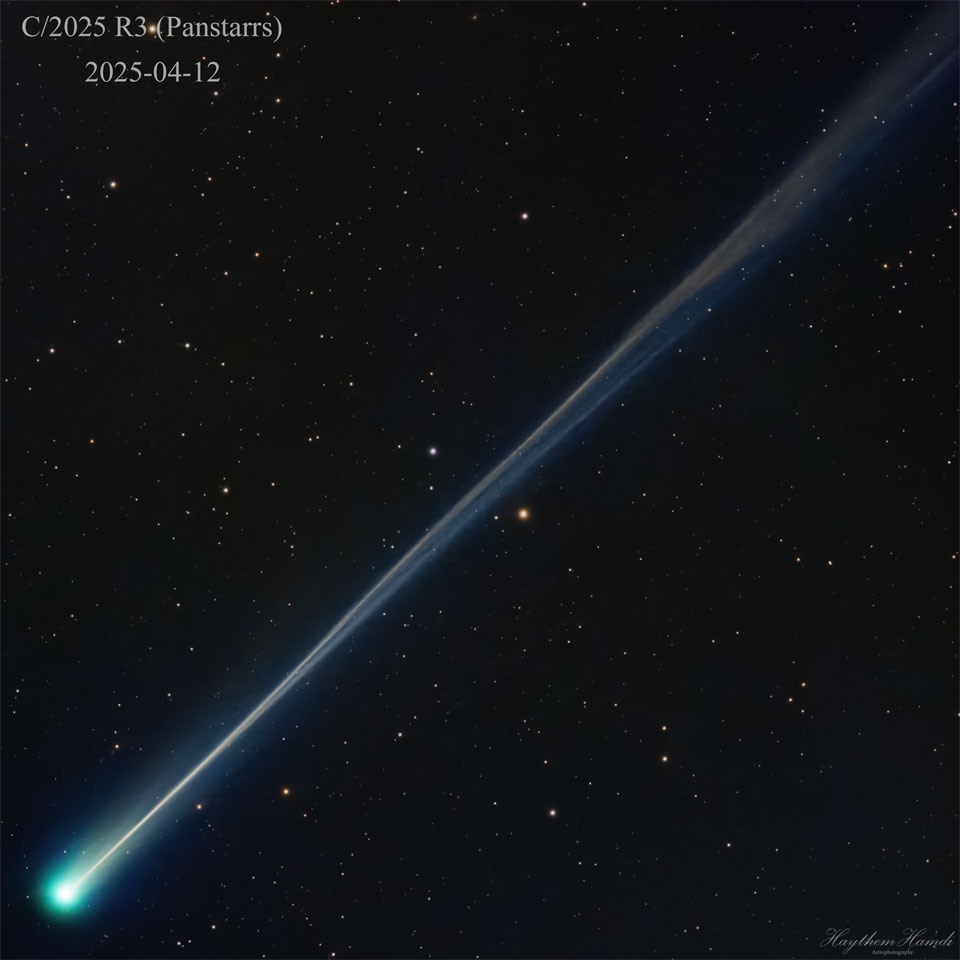
Image Credit: Haythem Hamdi
Explanation:
Why does Comet R3 (PanSTARRS) have a wispy tail?
The newest bright member of the inner Solar System, Comet C/2025 R3 (PanSTARRS) is already extending an impressive stream of glowing gas.
This tail starts from an unseen central nucleus of dirty ice that is likely a few kilometers across.
The nucleus is warmed by the Sun and emits a cloud of neutral gas into a coma that glows light green.
Nuclear gas ionized by energetic sunlight is pushed away from the Sun by the solar wind into an ion tail that glows light blue.
The wispy nature of the ion tail is caused by the constantly changing structure of the solar wind.
Pictured from Rhode Island, USA two days ago, Comet R3 (PanSTARRS) shows off a many-degree ion tail.
Comet R3 (PanSTARRS) is best seen before dawn from northern skies for another 10 days, after which it will be best visible from southern skies.
#APOD #CometR3 #PanSTARRS #Comets #Astronomy #Space
https://apod.nasa.gov/apod/ap260414.html
原始 JSON
{
  "kind": 1,
  "id": "77965e0004a5a327d5b659c90c74f6c9fced753ac0144848a00ad284d7c46f43",
  "pubkey": "e85ed75286cb77475776c1007df8c4ff1c9c68eff91c3627347b065c5bf4dc78",
  "created_at": 1776225989,
  "tags": [],
  "content": "**Astronomy Picture of the Day**\n\n15 April 2026\n\n**The Long Wispy Tail of Comet R3 (PanSTARRS)**\n\nhttps://apod.nasa.gov/apod/image/2604/CometR3_Hamdi_960.jpg\n\nImage Credit: Haythem Hamdi\n\nExplanation:  \nWhy does Comet R3 (PanSTARRS) have a wispy tail? \n\nThe newest bright member of the inner Solar System, \nComet C/2025 R3 (PanSTARRS) is already extending an \nimpressive stream of glowing gas.\n\nThis tail starts from an unseen \ncentral nucleus of dirty ice that is likely a few kilometers across.\n\nThe nucleus is warmed by the Sun and \nemits a cloud of neutral gas into a \ncoma that \nglows light green.\n\nNuclear gas ionized by \nenergetic sunlight is pushed away from the \nSun by the \nsolar wind into an ion tail that \nglows light blue. \n\nThe wispy nature of the \nion tail is caused by the \nconstantly changing structure of the solar wind. \n\nPictured from \nRhode Island, \nUSA two days ago, \nComet R3 (PanSTARRS) \nshows off a many-degree ion tail. \n\nComet R3 (PanSTARRS) is best seen before dawn from \nnorthern skies for another 10 days, after which it \nwill be best visible from southern skies.\n\n#APOD #CometR3 #PanSTARRS #Comets #Astronomy #Space\n\nhttps://apod.nasa.gov/apod/ap260414.html\n",
  "sig": "c5bf63ad2653a11dec4e7e9b60dc7c1f18ceeaeaf4fad6c99bf6007ded64109748594104e42bf4c20624db61ddf1fc6926bd92ae8a446f6a032b695bd7392bf4"
}