**Astronomy Picture of the Day**

npub1ap0dw55xedm5w4mkcyq8m7xyluwfc680lywrvfe50vr9ckl5m3uqtf5l75
hex
7937e6c1cf66cd5cd2a86d222dc876a01e9ab3022d24f6b46f06ec94c05ee310nevent
nevent1qqs8jdlxc88kdn2u625x6g3depm2q856kvpz6f8kk3hsdmy5cp0wxyqprpmhxue69uhhyetvv9ujuem4d36kwatvw5hx6mm9qgswshkh22rvka682amvzqralrz078yudrhlj8pkyu68kpjut06dc7q8y645pKind-1 (TextNote)
Astronomy Picture of the Day
12 June 2026
Venus and Jupiter: Conjunction from Avebury
Image: 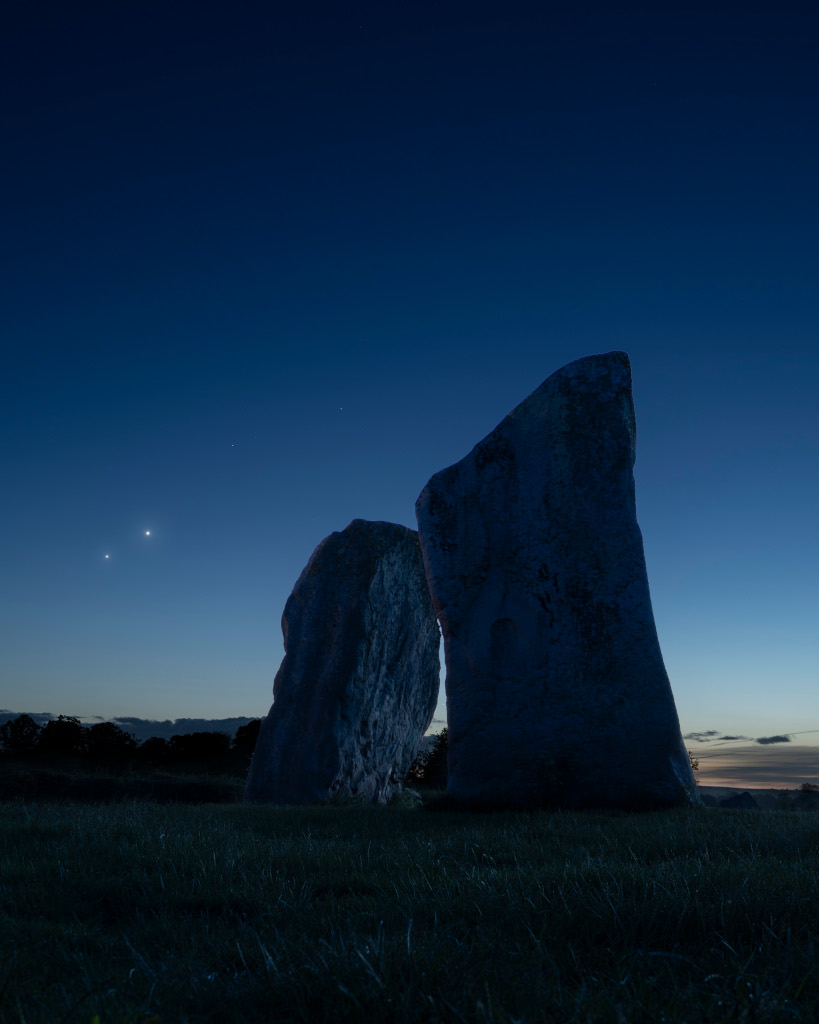
Credit: Josh Dury
Explanation: To see Venus and Jupiter together this month, you won't need binoculars or even a telescope. Just look up after sunset and you'll find them emerging as the sky grows dark near the western horizon. In fact, on June 9 the two brightest planets were in close conjunction, separated on the sky by less than 2 degrees from our perspective. Since (brighter) inner planet Venus orbits the Sun faster than outer planet Jupiter, it catches up with and passes the outer planet along the ecliptic roughly every 13 months. But every three years or so their resulting conjunction can be viewed far enough from the Sun to be easily seen in Earth's twilight skies. On June 9, the two celestial beacon's close "cosmic kiss" was captured here next to the two large standing stones at the cove within a 4,000 year old stone circle at Avebury , UK. Larger than Stonehenge , the Avebury henge and stone circle complex is also recognized as one of the most significant neolithic ceremonial sites on planet Earth.
#APOD #Science #Astronomy #Space #Astrophoto
https://apod.nasa.gov/apod/ap260612.html
Raw JSON
{
  "kind": 1,
  "id": "7937e6c1cf66cd5cd2a86d222dc876a01e9ab3022d24f6b46f06ec94c05ee310",
  "pubkey": "e85ed75286cb77475776c1007df8c4ff1c9c68eff91c3627347b065c5bf4dc78",
  "created_at": 1781237144,
  "tags": [],
  "content": "**Astronomy Picture of the Day**\n\n12 June 2026\n\n**Venus and Jupiter: Conjunction from Avebury**\n\nImage: https://apod.nasa.gov/apod/image/2606/CosmicKissTheCoveAveburyDury1024.jpg\n\nCredit: Josh Dury\n\nExplanation: To see Venus and Jupiter together this month, you won't need binoculars or even a telescope. Just look up after sunset and you'll find them emerging as the sky grows dark near the western horizon. In fact, on June 9 the two brightest planets were in close conjunction, separated on the sky by less than 2 degrees from our perspective. Since (brighter) inner planet Venus orbits the Sun faster than outer planet Jupiter, it catches up with and passes the outer planet along the ecliptic roughly every 13 months. But every three years or so their resulting conjunction can be viewed far enough from the Sun to be easily seen in Earth's twilight skies. On June 9, the two celestial beacon's close \"cosmic kiss\" was captured here next to the two large standing stones at the cove within a 4,000 year old stone circle at Avebury , UK. Larger than Stonehenge , the Avebury henge and stone circle complex is also recognized as one of the most significant neolithic ceremonial sites on planet Earth.\n\n#APOD #Science #Astronomy #Space #Astrophoto\n\nhttps://apod.nasa.gov/apod/ap260612.html\n",
  "sig": "26d9104591f079ed9c9f5907436d89bc1dd9e9a0a84bf3cabaf736aff944279074efd85cb54f12b6bb6b7adaab2978b8897cdfc5ad6ed6805b39d2cb77818ec6"
}