**Astronomy Picture of the Day**

npub1ap0dw55xedm5w4mkcyq8m7xyluwfc680lywrvfe50vr9ckl5m3uqtf5l75
hex
7b956ec0b944177ab03fdd7c758b7376e936e1607de6a01af263c14d9c1e4facnevent
nevent1qqs8h9twczu5g9m6kqla6lr43dehd6fku9s8me4qrtex8s2dns0yltqprpmhxue69uhhyetvv9ujuem4d36kwatvw5hx6mm9qgswshkh22rvka682amvzqralrz078yudrhlj8pkyu68kpjut06dc7q2a4rqwKind-1 (TextNote)
Astronomy Picture of the Day
14 May 2026
Messier Catalog at Uniform Scale
Image: 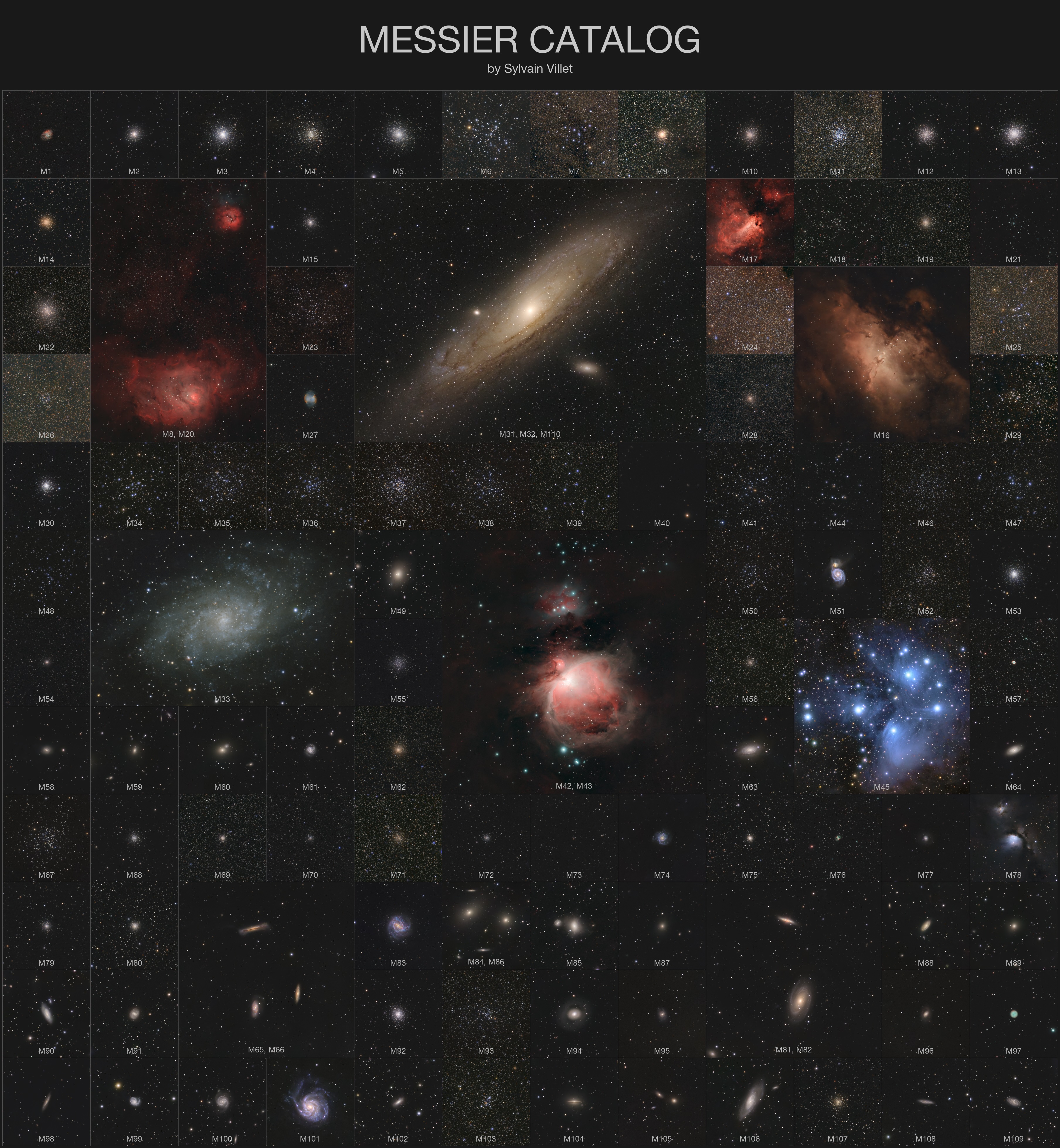
Image Credit: Sylvain Villet Text: Cecilia Chirenti ( NASA GSFC , UMCP , CRESST II )
What are some of the most interesting astronomical objects you can see in the night sky? Armed with a good pair of binoculars or a small telescope, if you live in the Northern Hemisphere, you can look for the very popular objects in the Messier Catalog . Most of them, but not all, are also visible from the southern half of the Earth. The featured image shows all 110 objects in the catalog at uniform scale -- the same magnification. Charles Messier created the catalog in the 18th century. He was interested in comets , and his catalog was a list of known comet-like " objects to avoid " in the sky when observing or hunting for comets. The deep sky objects in the catalog include a supernova remnant (the Crab Nebula , M1), other galaxies (such as Andromeda , M31), nebulae (e.g. the Orion Nebula , M42, a star-forming region) and stellar clusters (such as the Pleiades , M45, a bright young open cluster ).
#APOD #MessierCatalog #DeepSky #Astronomy #Skywatching #Stargazing
https://apod.nasa.gov/apod/ap260514.html
Raw JSON
{
  "kind": 1,
  "id": "7b956ec0b944177ab03fdd7c758b7376e936e1607de6a01af263c14d9c1e4fac",
  "pubkey": "e85ed75286cb77475776c1007df8c4ff1c9c68eff91c3627347b065c5bf4dc78",
  "created_at": 1778759314,
  "tags": [],
  "content": "**Astronomy Picture of the Day**\n\n14 May 2026\n\n**Messier Catalog at Uniform Scale**\n\nImage: https://apod.nasa.gov/apod/image/2605/messier_portrait_300px_160h.jpg\n\nImage Credit: Sylvain Villet Text: Cecilia Chirenti ( NASA GSFC , UMCP , CRESST II )\n\nWhat are some of the most interesting astronomical objects you can see in the night sky? Armed with a good pair of binoculars or a small telescope, if you live in the Northern Hemisphere, you can look for the very popular objects in the Messier Catalog . Most of them, but not all, are also visible from the southern half of the Earth. The featured image shows all 110 objects in the catalog at uniform scale -- the same magnification. Charles Messier created the catalog in the 18th century. He was interested in comets , and his catalog was a list of known comet-like \" objects to avoid \" in the sky when observing or hunting for comets. The deep sky objects in the catalog include a supernova remnant (the Crab Nebula , M1), other galaxies (such as Andromeda , M31), nebulae (e.g. the Orion Nebula , M42, a star-forming region) and stellar clusters (such as the Pleiades , M45, a bright young open cluster ).\n\n#APOD #MessierCatalog #DeepSky #Astronomy #Skywatching #Stargazing\n\nhttps://apod.nasa.gov/apod/ap260514.html\n",
  "sig": "eaf9727144d30e5801b9124c03d5f9c1883d293522e4b3bd9a067dfaf388d9c107279c296d930b3a670f12da8a1ea29dcbcb23061596d72bd8ab3a1781361788"
}