**Astronomy Picture of the Day**

npub1ap0dw55xedm5w4mkcyq8m7xyluwfc680lywrvfe50vr9ckl5m3uqtf5l75
hex
825da515c036e3c765ff2e06d031041894f738d398cb07ec46ca1b2708ff0d6bnevent
nevent1qqsgyhd9zhqrdc78vhljupksxyzp398h8rfe3jc8a3rv5xe8prls66cprpmhxue69uhhyetvv9ujuem4d36kwatvw5hx6mm9qgswshkh22rvka682amvzqralrz078yudrhlj8pkyu68kpjut06dc7qvqcludKind-1 (TextNote)
Astronomy Picture of the Day
30 June 2026
Unusually Smooth Sections of Asteroid Itokawa
Image: 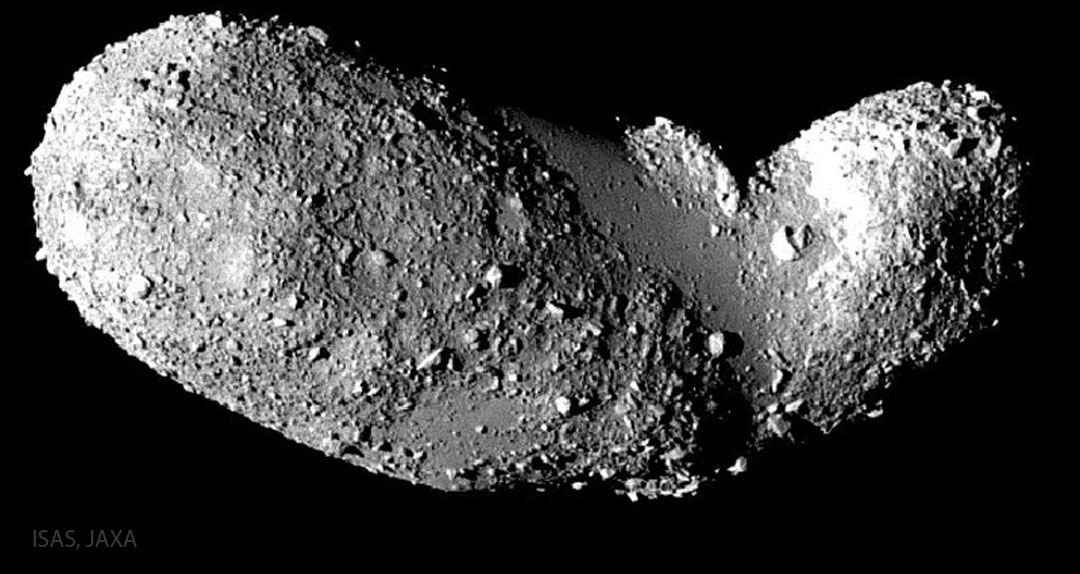
Image Credit: JAXA , ISAS
Why are parts of this asteroid's surface so smooth? The answer seems likely to do with the dynamics of an asteroid that is a loose pile of rubble rather than a solid rock. The unusual asteroid Itokawa was visited by the Japan ese spacecraft Hayabusa in 2005 which imaged and documented its unusual structure and mysterious lack of craters . Analyses of the border regions between smooth and rugged sections indicate that jostling of the asteroid might be creating segregation between large and small rocks near the surface, like the Brazil nut effect . The robotic Hayabusa actually touched down on one of the smooth patches, dubbed the MUSES Sea , and collected soil samples . These samples were returned to Earth and are not only giving clues to the ancient history of this unusual asteroid , but also about the early years of our entire Solar System . Computer simulations show that 500-meter asteroid Itokawa may impact the Earth within the next few million years.
#APOD #Asteroid #Itokawa #Hayabusa #RubblePile #SurfaceSmoothness
https://apod.nasa.gov/apod/ap260630.html
Raw JSON
{
  "kind": 1,
  "id": "825da515c036e3c765ff2e06d031041894f738d398cb07ec46ca1b2708ff0d6b",
  "pubkey": "e85ed75286cb77475776c1007df8c4ff1c9c68eff91c3627347b065c5bf4dc78",
  "created_at": 1782792332,
  "tags": [],
  "content": "**Astronomy Picture of the Day**\n\n30 June 2026\n\n**Unusually Smooth Sections of Asteroid Itokawa**\n\nImage: https://apod.nasa.gov/apod/image/2606/itokawa07_hayabusa_1080.jpg\n\nImage Credit: JAXA , ISAS\n\nWhy are parts of this asteroid's surface so smooth? The answer seems likely to do with the dynamics of an asteroid that is a loose pile of rubble rather than a solid rock. The unusual asteroid Itokawa was visited by the Japan ese spacecraft Hayabusa in 2005 which imaged and documented its unusual structure and mysterious lack of craters . Analyses of the border regions between smooth and rugged sections indicate that jostling of the asteroid might be creating segregation between large and small rocks near the surface, like the Brazil nut effect . The robotic Hayabusa actually touched down on one of the smooth patches, dubbed the MUSES Sea , and collected soil samples . These samples were returned to Earth and are not only giving clues to the ancient history of this unusual asteroid , but also about the early years of our entire Solar System . Computer simulations show that 500-meter asteroid Itokawa may impact the Earth within the next few million years.\n\n#APOD #Asteroid #Itokawa #Hayabusa #RubblePile #SurfaceSmoothness\n\nhttps://apod.nasa.gov/apod/ap260630.html\n",
  "sig": "4b6db391f516dd9812483f9551057250b7fc320ba0dc4cd89bf445b163ebfda1d6dd914f8ffb95d7b9bfe5b97ce07bb212e0a1b996e614060fda9439dc53798c"
}