**Astronomy Picture of the Day**

npub1ap0dw55xedm5w4mkcyq8m7xyluwfc680lywrvfe50vr9ckl5m3uqtf5l75
hex
89149946599f040ac1e411524ecd18f5afe2a33dd405e2d02218503a0abb44efnevent
nevent1qqsgj9yegeve7pq2c8jpz5jwe5v0ttlz5v7agp0z6q3ps5p6p2a5fmcprpmhxue69uhhyetvv9ujuem4d36kwatvw5hx6mm9qgswshkh22rvka682amvzqralrz078yudrhlj8pkyu68kpjut06dc7qmgwqauKind-1 (TextNote)
Astronomy Picture of the Day
14 June 2026
10 Days of Venus and Jupiter
Image: 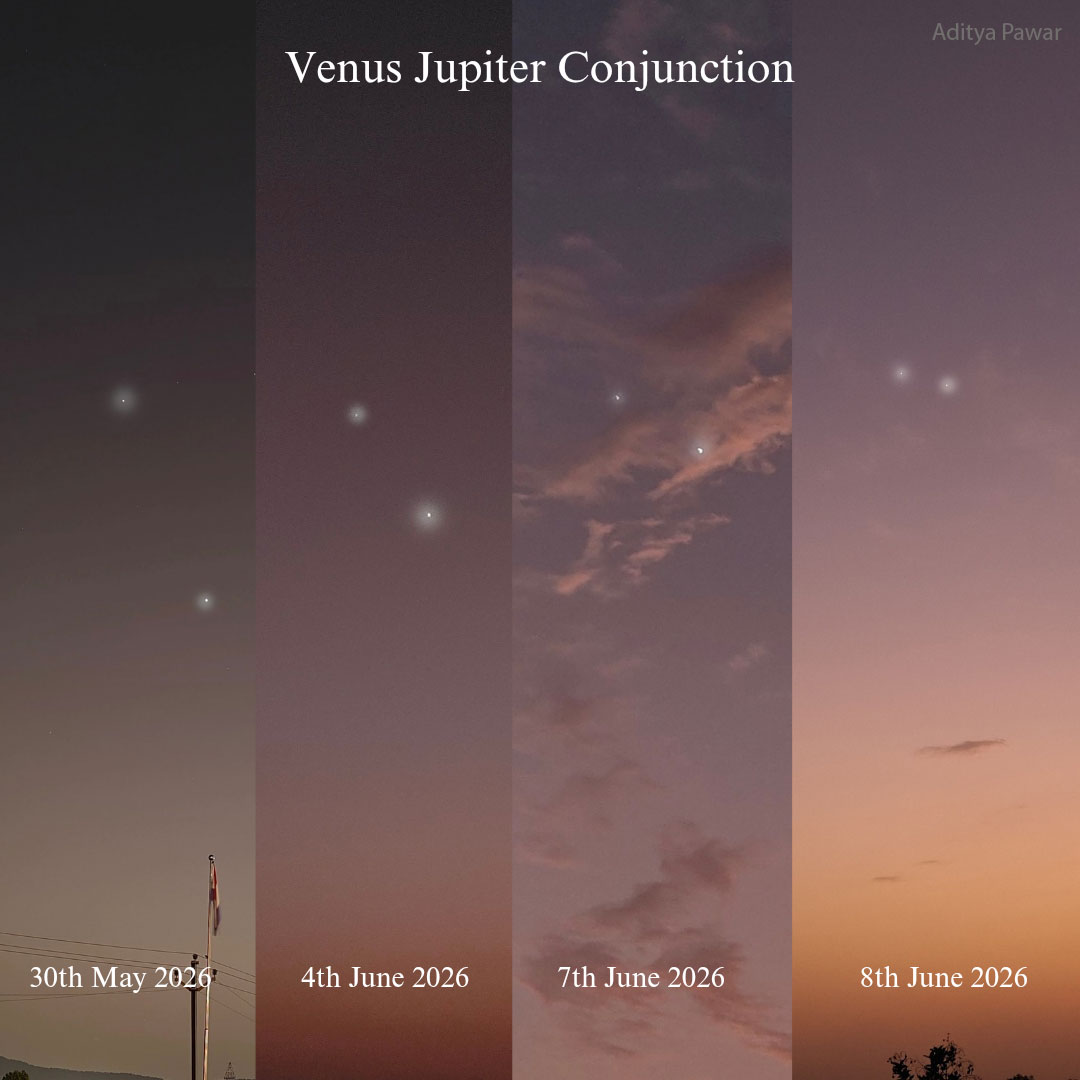
Credit: Not provided
Venus and Jupiter may have caught your attention lately. The recent close conjunction of the two brightest planets in recent evening skies has been hard to miss . With Jupiter at the top, starting on May 30 and ending on June 8, their close approach was chronicled daily, left to right, in the featured panels from Maharashtra , India . Near the western horizon, the evening sky colors and exposures used for each panel depend on the local conditions near sunset. At their closest on June 9, the celestial pair appeared to be only about three times the width of a full moon apart. Of course, on that date, the two planets were physically separated by over 600 million kilometers in their orbits around the Sun . In the coming days, Jupiter will slowly settle into the sunset glare, but Venus will continue to move farther from the Sun in the western sky to excel in its current role as the brilliant evening star .
#APOD #NASAInspires #lookUp #Astroeducation #Astronomy
https://apod.nasa.gov/apod/ap260614.html
Raw JSON
{
  "kind": 1,
  "id": "89149946599f040ac1e411524ecd18f5afe2a33dd405e2d02218503a0abb44ef",
  "pubkey": "e85ed75286cb77475776c1007df8c4ff1c9c68eff91c3627347b065c5bf4dc78",
  "created_at": 1781410080,
  "tags": [],
  "content": "**Astronomy Picture of the Day**\n\n14 June 2026\n\n**10 Days of Venus and Jupiter**\n\nImage: https://apod.nasa.gov/apod/image/2606/VenusJupiter10_Pawar_1080.jpg\n\nCredit: Not provided\n\nVenus and Jupiter may have caught your attention lately. The recent close conjunction of the two brightest planets in recent evening skies has been hard to miss . With Jupiter at the top, starting on May 30 and ending on June 8, their close approach was chronicled daily, left to right, in the featured panels from Maharashtra , India . Near the western horizon, the evening sky colors and exposures used for each panel depend on the local conditions near sunset. At their closest on June 9, the celestial pair appeared to be only about three times the width of a full moon apart. Of course, on that date, the two planets were physically separated by over 600 million kilometers in their orbits around the Sun . In the coming days, Jupiter will slowly settle into the sunset glare, but Venus will continue to move farther from the Sun in the western sky to excel in its current role as the brilliant evening star .\n\n#APOD #NASAInspires #lookUp #Astroeducation #Astronomy\n\nhttps://apod.nasa.gov/apod/ap260614.html\n",
  "sig": "7a1f9427757a42e6d5ffc02d31c6cf11dc5b0328121b1576e22d6867ad6db8ef86b22e89459ccfda062a3a0a929b97f0fd94b23134975a62a1fbc6e5c7406f86"
}