**Astronomy Picture of the Day**

npub1ap0dw55xedm5w4mkcyq8m7xyluwfc680lywrvfe50vr9ckl5m3uqtf5l75
hex
8c34d1054ee7a89fefaf45a63f98407bf61c8edb0c9da8ded66ca80b61bcfe4fnevent
nevent1qqsgcdx3q48w02yla7h5tf3lnpq8hasu3mdse8dgmmtxe2qtvx70uncprpmhxue69uhhyetvv9ujuem4d36kwatvw5hx6mm9qgswshkh22rvka682amvzqralrz078yudrhlj8pkyu68kpjut06dc7qjns8c2Kind-1 (TextNote)
Astronomy Picture of the Day
12 March 2026
CG 4: The Globule and the Galaxy
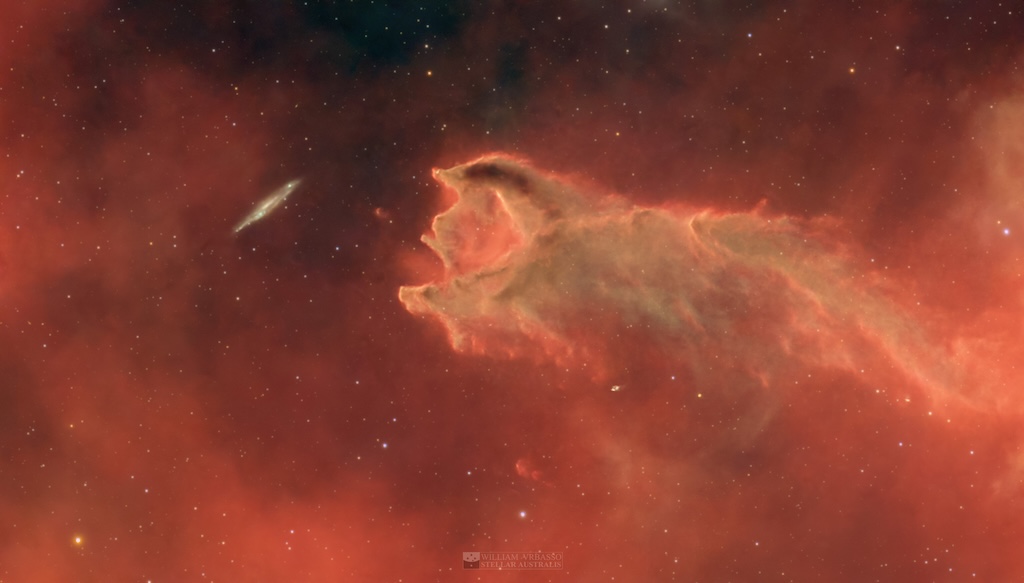
Image Credit: William Vrbasso, Cecilia Chirenti, NASA, GSFC, CRESST II
Explanation:
Is this a cosmic monster ready to devour an unsuspecting galaxy?
Thankfully, that is not the case.
The red “monster” shown in the featured image is Cometary Globule CG 4, 1,300 light-years away in the Constellation Puppis.
CG 4 is a molecular cloud, where hydrogen becomes cold enough to form molecules that can be brought together by gravity to create stars.
The shape of CG 4 resembles that of a comet, but its head is 1.5 light-year in diameter and its tail is 8 light-years long; for comparison, the distance from the Earth to the sun is only 8 light-minutes.
Astronomers believe that the tail of a cometary globule could have been shaped by a nearby supernova explosion or by irradiation from hot, massive stars. Indeed, CG 4 and other nearby globules point away from the Vela Supernova Remnant, at the center of the Gum Nebula.
The edge-on spiral galaxy, ESO 257-19, is more than a hundred million light-years beyond CG 4, and is completely safe from the “monster”.
#APOD #CG4 #Globule #Galaxy #CosmicMonster #InterstellarMedium
https://apod.nasa.gov/apod/ap260311.html
Raw JSON
{
  "kind": 1,
  "id": "8c34d1054ee7a89fefaf45a63f98407bf61c8edb0c9da8ded66ca80b61bcfe4f",
  "pubkey": "e85ed75286cb77475776c1007df8c4ff1c9c68eff91c3627347b065c5bf4dc78",
  "created_at": 1773289161,
  "tags": [],
  "content": "**Astronomy Picture of the Day**\n\n12 March 2026\n\n**CG 4: The Globule and the Galaxy**\n\nhttps://apod.nasa.gov/apod/image/2603/cg4_1024.jpg\n\nImage Credit: William Vrbasso, Cecilia Chirenti, NASA, GSFC, CRESST II\n\nExplanation:  \nIs this a cosmic monster ready to devour an unsuspecting galaxy?\n\nThankfully, that is not the case.\n\nThe red “monster” shown in the featured image is Cometary Globule CG 4, 1,300 light-years away in the Constellation Puppis.\n\nCG 4 is a molecular cloud, where hydrogen becomes cold enough to form molecules that can be brought together by gravity to create stars.\n\nThe shape of CG 4 resembles that of a comet, but its head is 1.5 light-year in diameter and its tail is 8 light-years long; for comparison, the distance from the Earth to the sun is only 8 light-minutes.\n\nAstronomers believe that the tail of a cometary globule could have been shaped by a nearby supernova explosion or by irradiation from hot, massive stars. Indeed, CG 4 and other nearby globules point away from the Vela Supernova Remnant, at the center of the Gum Nebula.\n\nThe edge-on spiral galaxy, ESO 257-19, is more than a hundred million light-years beyond CG 4, and is completely safe from the “monster”.\n\n#APOD #CG4 #Globule #Galaxy #CosmicMonster #InterstellarMedium\n\nhttps://apod.nasa.gov/apod/ap260311.html\n",
  "sig": "8955abaf86724219522a7cb7dcd0dd290f516cf8091d9bbb2862b05176546ecf95a70f04b005efbcf7c3716903136367d65f2671d09cc207333c3bcbd4d4d285"
}