**Astronomy Picture of the Day**

npub1ap0dw55xedm5w4mkcyq8m7xyluwfc680lywrvfe50vr9ckl5m3uqtf5l75
hex
9b00461f9295818cbc2308397dbccae428b87149ab49e65fbcaa47c6f095a480nevent
nevent1qqsfkqzxr7fftqvvhs3sswtahn9wg29cw9y6kj0xt772537x7z26fqqprpmhxue69uhhyetvv9ujuem4d36kwatvw5hx6mm9qgswshkh22rvka682amvzqralrz078yudrhlj8pkyu68kpjut06dc7q2uv2hfKind-1 (TextNote)
Astronomy Picture of the Day
31 March 2026
Peculiar Elliptical Galaxy Centaurus A
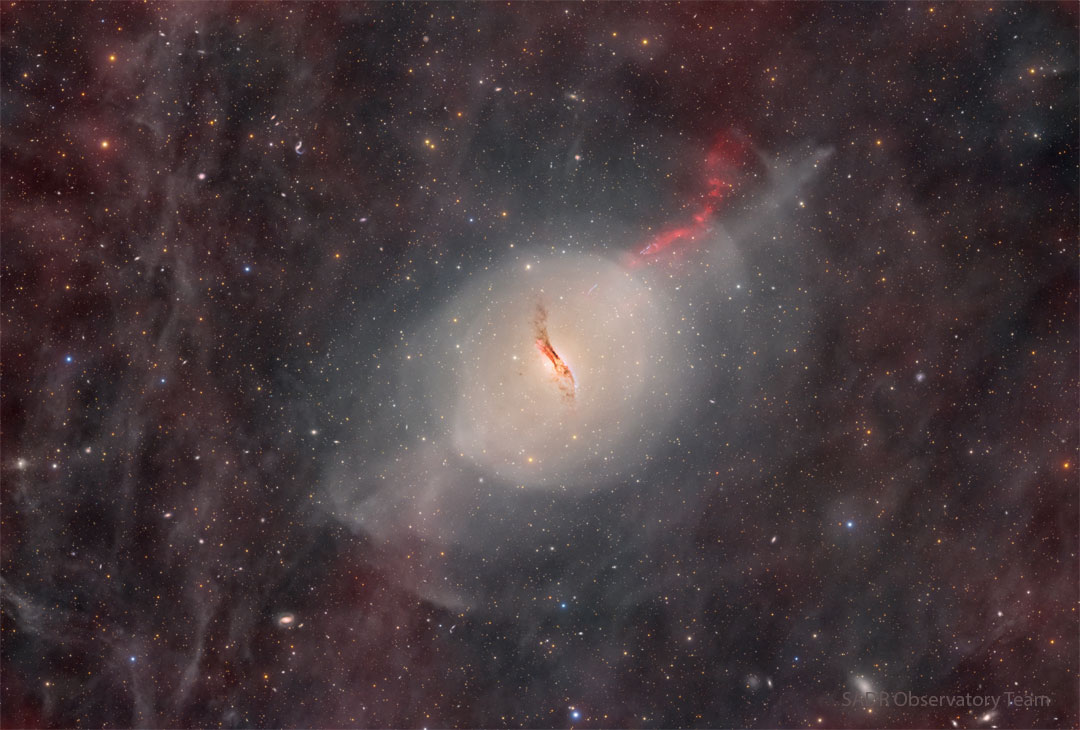
Image Credit: SADR Observatory, J-C Dalouzy
Explanation:
What's happened to the center of this galaxy?
Dramatic dust lanes run across the center of unusual elliptical galaxy Centaurus A.
These dust lanes are so thick they almost completely obscure the galaxy's center in visible light.
This is particularly unusual as Cen A's older stars and oval shape are characteristic of a giant elliptical galaxy, a galaxy type typically low in dark dust.
Pictured in this deep image is a complex network of foreground gas and dust, as well as shells of dim stars and a jet projecting to the upper right.
Also known as NGC 5128, Cen A is surely the result of a galactic collision where many young dust-creating stars were formed.
However, details of the creation of Cen A's unusually active center and iconic central dust lanes are still being researched.
Cen A lies only 13 million light years away, making it the closest active galaxy.
#APOD #CentaurusA #CenA #EllipticalGalaxy #ActiveGalacticNucleus #AGN
https://apod.nasa.gov/apod/ap260330.html
Raw JSON
{
  "kind": 1,
  "id": "9b00461f9295818cbc2308397dbccae428b87149ab49e65fbcaa47c6f095a480",
  "pubkey": "e85ed75286cb77475776c1007df8c4ff1c9c68eff91c3627347b065c5bf4dc78",
  "created_at": 1774931037,
  "tags": [],
  "content": "**Astronomy Picture of the Day**\n\n31 March 2026\n\n**Peculiar Elliptical Galaxy Centaurus A**\n\nhttps://apod.nasa.gov/apod/image/2603/CenA_SADR_1080.jpg\n\nImage Credit: SADR Observatory, J-C Dalouzy\n\nExplanation:  \nWhat's happened to the center of this galaxy? \n\nDramatic dust lanes run across the center of unusual elliptical galaxy \nCentaurus A.\n\nThese dust lanes are so thick they almost completely obscure the \ngalaxy's center in \nvisible light. \n\nThis is particularly unusual as \nCen A's \nolder stars and oval shape are characteristic of a giant \nelliptical galaxy, a galaxy type typically low in dark dust. \n\nPictured in \nthis deep image \nis a complex network of foreground gas and dust, as well as \nshells of dim stars and a \njet projecting to the upper right. \n\nAlso known as NGC 5128, \nCen A is surely the result of a \ngalactic collision where many young dust-creating stars were formed. \n\nHowever, details of the creation of Cen A's unusually \nactive center and iconic central dust lanes are still \nbeing researched. \n\nCen A lies only 13 million \nlight years away, making it the \nclosest active galaxy.\n\n#APOD #CentaurusA #CenA #EllipticalGalaxy #ActiveGalacticNucleus #AGN\n\nhttps://apod.nasa.gov/apod/ap260330.html\n",
  "sig": "5d154cd544a46d2129db43d49347390fcbb91abfdeef711da00acac9f44af19e9f9bd041d06104c17f71c6acb7c7b1a6fbb62d2e38c767f47d452848fff65644"
}