**Astronomy Picture of the Day**

npub1ap0dw55xedm5w4mkcyq8m7xyluwfc680lywrvfe50vr9ckl5m3uqtf5l75
hex
a67055d2a035aefaabcd1cc132373511fcd13e76849efdafc4cf5923b6d7c738nevent
nevent1qqs2vuz462srtth640x3esfjxu63rlx38emgf8ha4lzv7kfrkmtuwwqprpmhxue69uhhyetvv9ujuem4d36kwatvw5hx6mm9qgswshkh22rvka682amvzqralrz078yudrhlj8pkyu68kpjut06dc7qmkhw0lKind-1 (TextNote)
Astronomy Picture of the Day
06 May 2026
The Retrograde Dance of Saturn and Neptune
Image: 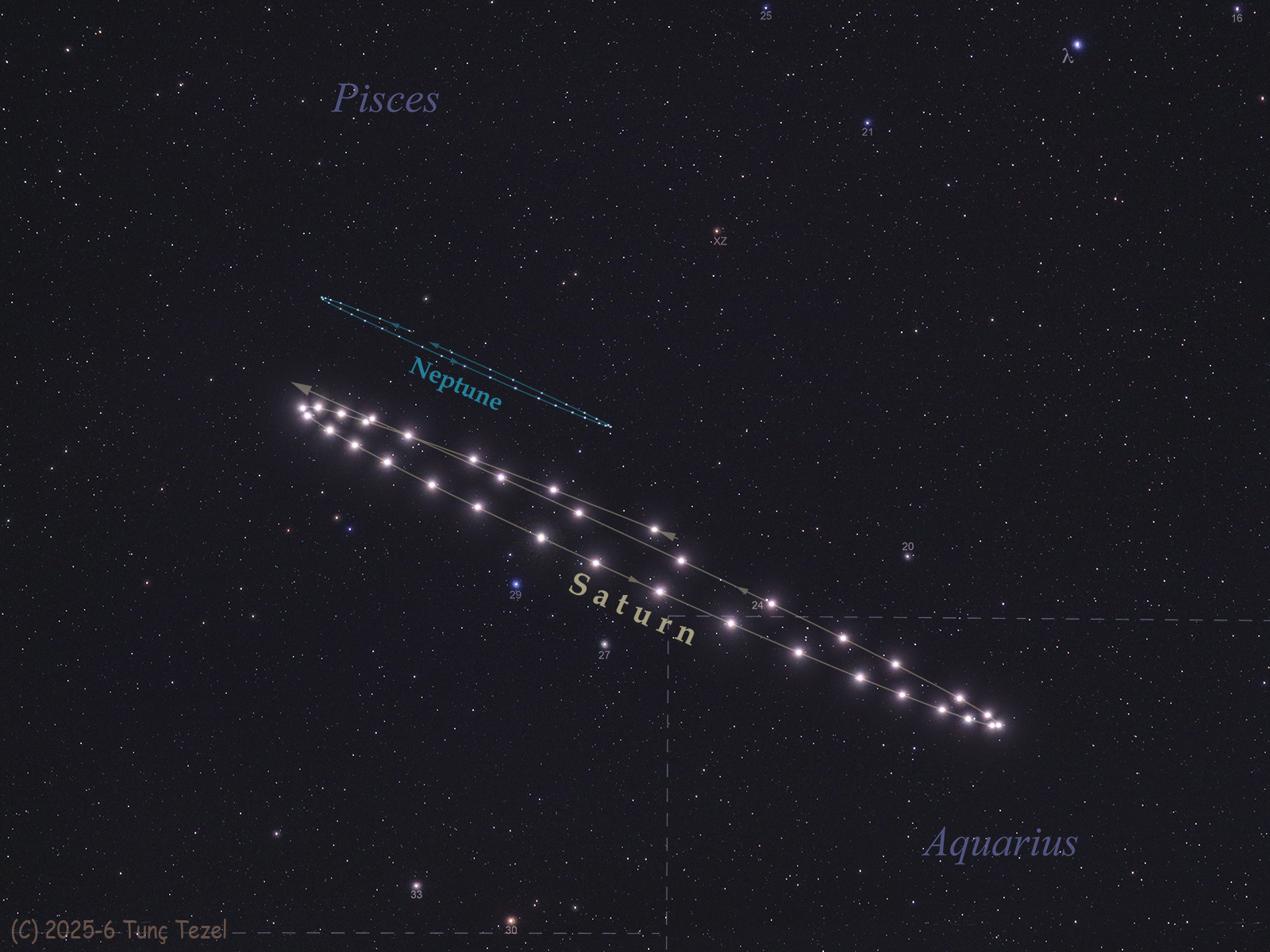
Credit: Not provided
What does it mean for Saturn and Neptune to be in retrograde? Featured is a composite of images taken over 34 nights from May 2025 to February 2026 tracing Saturn (brighter, foreground) and Neptune (dimmer, background). Over that time, the two planets exhibited retrograde motion , meaning they appeared to move backward in the sky. This apparent backwards motion occurs when Earth overtakes the slower outer planets as they orbit the Sun. Imagine the Solar System is a running track. Earth "runs" faster along the inside of the track compared to the outer planets. As Earth approaches, aligns, and then "laps" the outer planets, they change position from ahead to behind from the Earth's perspective. This perspective shift is what causes the outer planets to change position in the night sky. An animation corresponding to today’s image shows Saturn and Neptune’s months-long dance across the northern night sky. Saturn stepped from the Pisces constellation into Aquarius and back again while Neptune remained in Pisces. This is the closest Saturn and Neptune have been in the sky since their last conjunction in 1989.
#APOD #Saturn #Neptune #Retrograde #PlanetaryMotion #Astronomy
https://apod.nasa.gov/apod/ap260506.html
Raw JSON
{
  "kind": 1,
  "id": "a67055d2a035aefaabcd1cc132373511fcd13e76849efdafc4cf5923b6d7c738",
  "pubkey": "e85ed75286cb77475776c1007df8c4ff1c9c68eff91c3627347b065c5bf4dc78",
  "created_at": 1778040588,
  "tags": [],
  "content": "**Astronomy Picture of the Day**\n\n06 May 2026\n\n**The Retrograde Dance of Saturn and Neptune**\n\nImage: https://apod.nasa.gov/apod/image/2605/saturn_neptune_retrograde.jpg\n\nCredit: Not provided\n\nWhat does it mean for Saturn and Neptune to be in retrograde? Featured is a composite of images taken over 34 nights from May 2025 to February 2026 tracing Saturn (brighter, foreground) and Neptune (dimmer, background). Over that time, the two planets exhibited retrograde motion , meaning they appeared to move backward in the sky. This apparent backwards motion occurs when Earth overtakes the slower outer planets as they orbit the Sun. Imagine the Solar System is a running track. Earth \"runs\" faster along the inside of the track compared to the outer planets. As Earth approaches, aligns, and then \"laps\" the outer planets, they change position from ahead to behind from the Earth's perspective. This perspective shift is what causes the outer planets to change position in the night sky. An animation corresponding to today’s image shows Saturn and Neptune’s months-long dance across the northern night sky. Saturn stepped from the Pisces constellation into Aquarius and back again while Neptune remained in Pisces. This is the closest Saturn and Neptune have been in the sky since their last conjunction in 1989.\n\n#APOD #Saturn #Neptune #Retrograde #PlanetaryMotion #Astronomy\n\nhttps://apod.nasa.gov/apod/ap260506.html\n",
  "sig": "fccbc75b7f4c01ba108d321cb0ec3ba1adfe79879a2ac4ce5b5cb7e60ef0d34250d4890809c8065dc0d563824801cf5e75b6b704af3f7faa983b31dac9d9b2da"
}