**Astronomy Picture of the Day**

npub1ap0dw55xedm5w4mkcyq8m7xyluwfc680lywrvfe50vr9ckl5m3uqtf5l75
hex
b3324b41e2a8e3c700d98134c07453271c953aaef3b2abb1de262b24eb96bba1nevent
nevent1qqstxvjtg8323c78qrvczdxqw3fjw8y482h08v4tk80zv2eyawtthggprpmhxue69uhhyetvv9ujuem4d36kwatvw5hx6mm9qgswshkh22rvka682amvzqralrz078yudrhlj8pkyu68kpjut06dc7q90748wKind-1 (TextNote)
Astronomy Picture of the Day
20 April 2026
Eye on the Milky Way
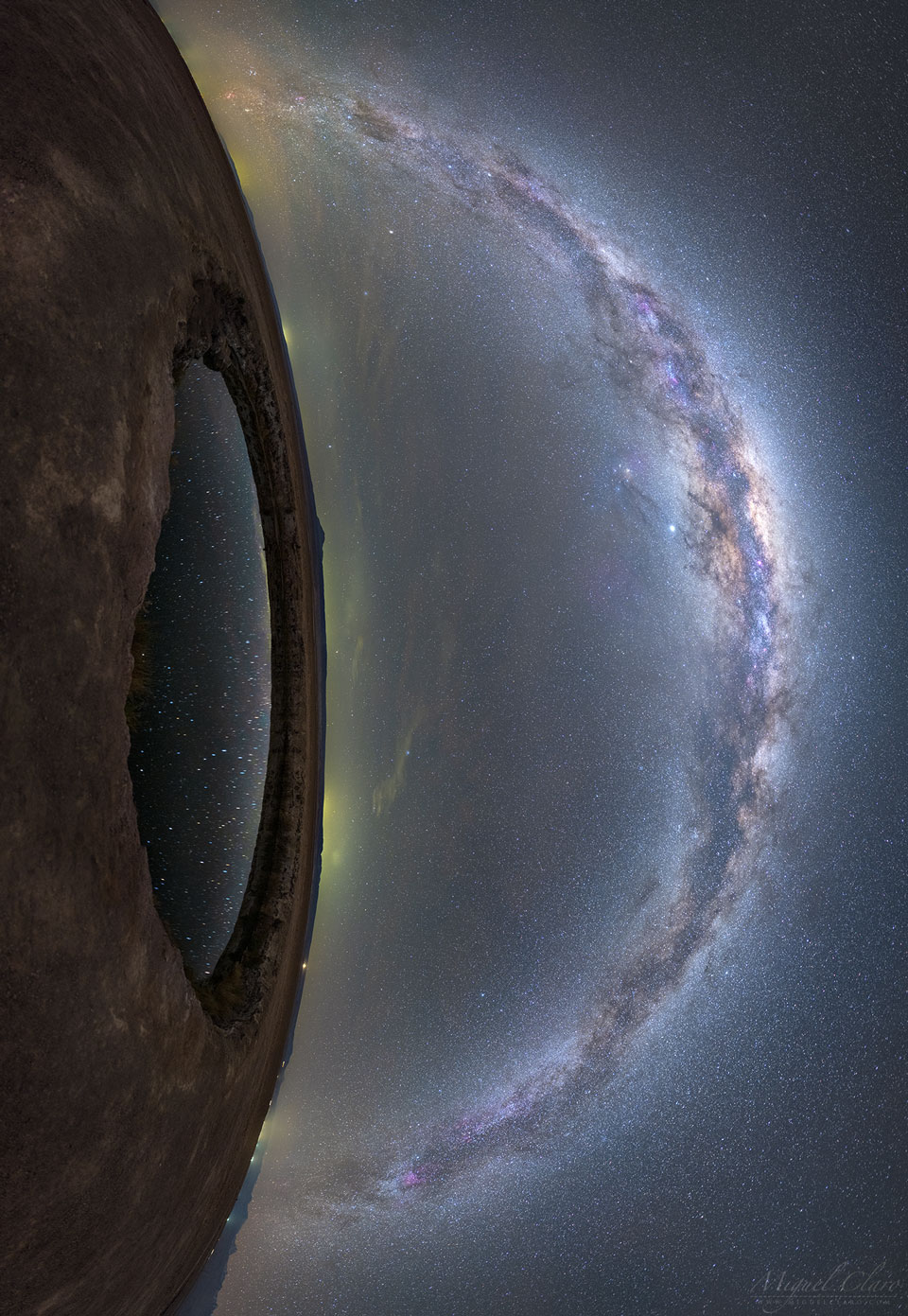
Image Credit: Miguel Claro, TWAN, Dark Sky Alqueva
Explanation:
Have you ever had
stars in your eyes?
It appears that the eye on the left does, and moreover, it appears to be gazing at even more stars.
The featured 27-frame mosaic was taken in 2019 from Ojas de Salar in the Atacama Desert of Chile.
The eye is actually a small lagoon captured reflecting the dark night sky as the Milky Way Galaxy arched overhead.
The seemingly smooth band of the Milky Way is really composed of billions of stars, but decorated with filaments of light-absorbing dust and red-glowing nebulas.
Additionally, both Jupiter (slightly left the galactic arch) and Saturn (slightly to the right) are visible.
The lights of small towns dot the unusual vertical horizon.
The rocky terrain around the lagoon appears to some more like the surface of Mars than our Earth.
#APOD #MilkyWay #Galaxy #Astronomy #Space #Stars
https://apod.nasa.gov/apod/ap260419.html
原始 JSON
{
  "kind": 1,
  "id": "b3324b41e2a8e3c700d98134c07453271c953aaef3b2abb1de262b24eb96bba1",
  "pubkey": "e85ed75286cb77475776c1007df8c4ff1c9c68eff91c3627347b065c5bf4dc78",
  "created_at": 1776658034,
  "tags": [],
  "content": "**Astronomy Picture of the Day**\n\n20 April 2026\n\n**Eye on the Milky Way**\n\nhttps://apod.nasa.gov/apod/image/2604/EyeOnMW_Claro_960.jpg\n\nImage Credit: Miguel Claro, TWAN, Dark Sky Alqueva\n\nExplanation:  \nHave you ever had \nstars in your eyes?\n\nIt appears that the eye on the left does, and moreover, it appears to be gazing at even more stars.\n\nThe \nfeatured 27-frame mosaic was taken in 2019 from \nOjas de Salar in the \nAtacama Desert of \nChile. \n\nThe eye is actually a small \nlagoon captured reflecting the \ndark night sky \nas the Milky Way Galaxy arched overhead.\n\nThe seemingly smooth band of the \nMilky Way is really composed of billions of stars, \nbut decorated with filaments of light-absorbing dust and \nred-glowing nebulas.\n\nAdditionally, both \nJupiter \n(slightly left the galactic arch) and \nSaturn \n(slightly to the right) are visible. \n\nThe lights of small towns dot the \nunusual vertical horizon. \n\nThe rocky terrain around the \nlagoon appears to some more like the surface of \nMars than our \nEarth.\n\n#APOD #MilkyWay #Galaxy #Astronomy #Space #Stars\n\nhttps://apod.nasa.gov/apod/ap260419.html\n",
  "sig": "0cd28ab08dc837618caeea4b41c84c45819eee2034720f144c066901a5a1ca5f4c6f6d34a5f98f072a5c023178757ee50e01833a7f3efd93bf15b84203b120c9"
}