**Astronomy Picture of the Day**

npub1ap0dw55xedm5w4mkcyq8m7xyluwfc680lywrvfe50vr9ckl5m3uqtf5l75
hex
bb29e7794677dfffde61cb419b0d90064b2a195bf78ec72210656e3272c92f70nevent
nevent1qqstk20809r80hllmesuksvmpkgqvje2r9dl0rk8yggx2m3jwtyj7uqprpmhxue69uhhyetvv9ujuem4d36kwatvw5hx6mm9qgswshkh22rvka682amvzqralrz078yudrhlj8pkyu68kpjut06dc7qzpaauwKind-1 (TextNote)
Astronomy Picture of the Day
06 April 2026
NGC 3310: A Starburst Spiral Galaxy
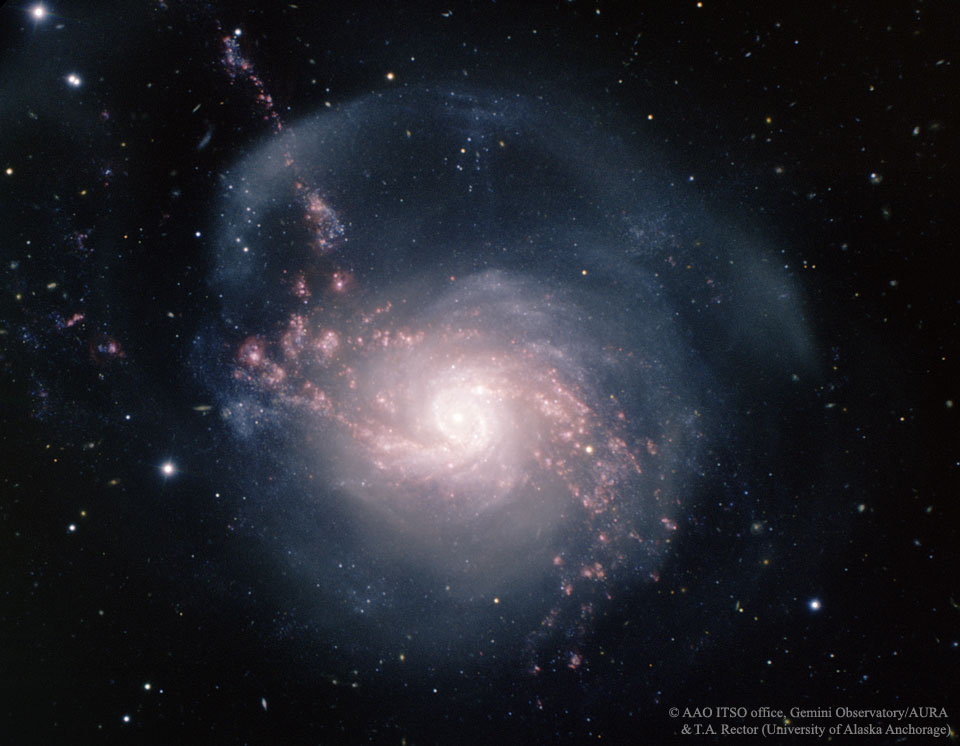
Image Credit: AAO ITSO Office, Gemini Obs., AURA, T. A. Rector, U. Alaska Anchorage
Explanation:
The party is still going on in spiral galaxy NGC 3310.
Roughly 100 million years ago, NGC 3310 likely collided with a smaller galaxy causing the large spiral galaxy to light up with a tremendous burst of star formation.
The changing gravity during the collision created density waves that compressed existing clouds of gas and triggered the star-forming party.
The featured image from the Gemini North Telescope shows the galaxy in great detail, color-coded so that pink highlights gas while white and blue highlight stars.
Some of the star clusters in the galaxy are quite young, indicating that starburst galaxies may remain in star-burst mode for quite some time.
NGC 3310 spans about 50,000 light years, lies about 50 million light years away, and is visible with a small telescope towards the constellation of Great Bear Ursa Major.
#APOD #NGC3310 #StarburstGalaxy #SpiralGalaxy #GalaxyCollision #StarFormation
https://apod.nasa.gov/apod/ap260405.html
Raw JSON
{
  "kind": 1,
  "id": "bb29e7794677dfffde61cb419b0d90064b2a195bf78ec72210656e3272c92f70",
  "pubkey": "e85ed75286cb77475776c1007df8c4ff1c9c68eff91c3627347b065c5bf4dc78",
  "created_at": 1775449332,
  "tags": [],
  "content": "**Astronomy Picture of the Day**\n\n06 April 2026\n\n**NGC 3310: A Starburst Spiral Galaxy**\n\nhttps://apod.nasa.gov/apod/image/2604/ngc3310_gemini_960.jpg\n\nImage Credit: AAO ITSO Office, Gemini Obs., AURA, T. A. Rector, U. Alaska Anchorage\n\nExplanation:  \nThe party is still going on in spiral galaxy NGC 3310.  \n\nRoughly 100 million years ago, \nNGC 3310 likely \ncollided with a smaller galaxy \ncausing the large \nspiral galaxy \nto light up with a tremendous burst of \nstar formation.  \n\nThe changing gravity during the collision created \ndensity waves that compressed existing \nclouds of gas and triggered the \nstar-forming party.  \n\nThe featured image from the \nGemini North Telescope shows the galaxy in great detail, \ncolor-coded so that pink highlights gas \nwhile white and blue highlight stars. \n\nSome of the \nstar clusters \nin the galaxy are quite young, indicating that \nstarburst galaxies may remain in \nstar-burst mode for quite some time.  \n\nNGC 3310 spans about 50,000 light years, lies about 50 million light years away, \nand is visible with a small telescope towards the constellation of Great Bear \nUrsa Major.\n\n#APOD #NGC3310 #StarburstGalaxy #SpiralGalaxy #GalaxyCollision #StarFormation\n\nhttps://apod.nasa.gov/apod/ap260405.html\n",
  "sig": "4d643f26b37f5df6ad4906038008a9f8720e08d7fb294ef8802077dc4ab0423f9c78ed61270ed33f93ae52203698015c5e72386e408fbc6ff6b7a21ad10a5dc7"
}