**Astronomy Picture of the Day**

npub1ap0dw55xedm5w4mkcyq8m7xyluwfc680lywrvfe50vr9ckl5m3uqtf5l75
hex
bd8d3edd93961d103032163abf5e0b127796bc00bd2f5238a518284848d9a3bdnevent
nevent1qqstmrf7mkfev8gsxqepvw4ltc93yaukhsqt6t6j8zj3s2zgfrv680gprpmhxue69uhhyetvv9ujuem4d36kwatvw5hx6mm9qgswshkh22rvka682amvzqralrz078yudrhlj8pkyu68kpjut06dc7qy9xtx7Kind-1 (TextNote)
Astronomy Picture of the Day
09 May 2026
Messier Craters in Stereo
Image: 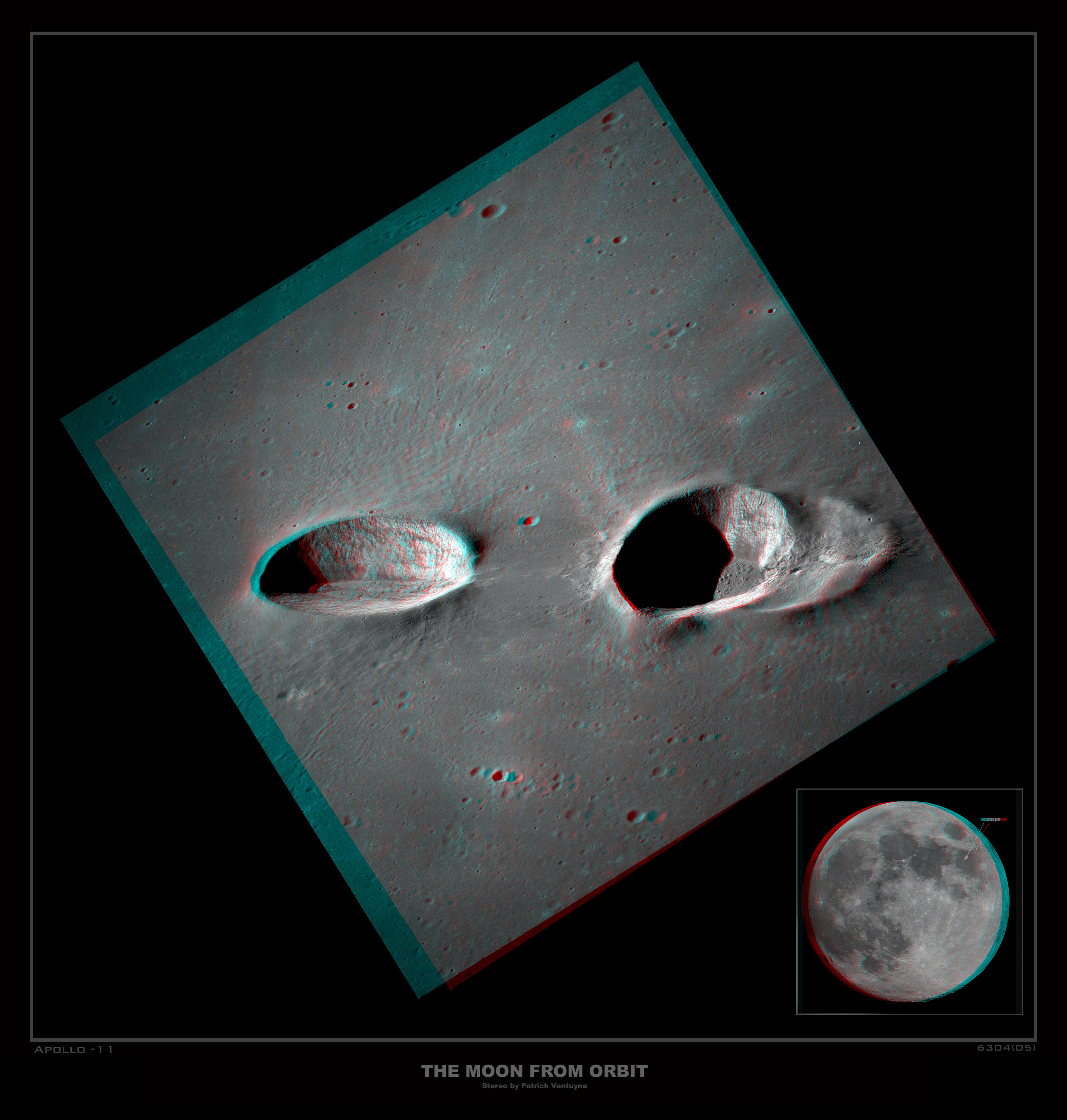
Image Credit: Apollo 11 , NASA ; Stereo Image Copyright Patrick Vantuyne
Many bright nebulae and star clusters in planet Earth's sky are associated with the name of astronomer Charles Messier from his famous 18th century catalog. His name is also given to these two large and remarkable craters on the Moon. Standouts in the dark , smooth lunar Sea of Fertility or Mare Fecunditatis, Messier (left) and Messier A have dimensions of 15 by 8 and 16 by 11 kilometers respectively. Their elongated shapes are explained by the extremely shallow-angle trajectory followed by an impactor, moving left to right, that gouged out the craters. The shallow impact also resulted in two bright rays of material extending along the surface to the right, beyond the picture. Intended to be viewed with red/blue glasses (red for the left eye), this striking stereo picture of the crater pair was recently created from high resolution scans of two images ( AS11-42-6304 , AS11-42-6305 ) taken during the Apollo 11 mission to the Moon.
#APOD #MessierCraters #LunarCraters #MareFecunditatis #LunarSurface #StellarImpact
https://apod.nasa.gov/apod/ap260509.html
Raw JSON
{
  "kind": 1,
  "id": "bd8d3edd93961d103032163abf5e0b127796bc00bd2f5238a518284848d9a3bd",
  "pubkey": "e85ed75286cb77475776c1007df8c4ff1c9c68eff91c3627347b065c5bf4dc78",
  "created_at": 1778299561,
  "tags": [],
  "content": "**Astronomy Picture of the Day**\n\n09 May 2026\n\n**Messier Craters in Stereo**\n\nImage: https://apod.nasa.gov/apod/image/2605/MessierCrater3d_vantuyne.jpg\n\nImage Credit: Apollo 11 , NASA ; Stereo Image Copyright Patrick Vantuyne\n\nMany bright nebulae and star clusters in planet Earth's sky are associated with the name of astronomer Charles Messier from his famous 18th century catalog. His name is also given to these two large and remarkable craters on the Moon. Standouts in the dark , smooth lunar Sea of Fertility or Mare Fecunditatis, Messier (left) and Messier A have dimensions of 15 by 8 and 16 by 11 kilometers respectively. Their elongated shapes are explained by the extremely shallow-angle trajectory followed by an impactor, moving left to right, that gouged out the craters. The shallow impact also resulted in two bright rays of material extending along the surface to the right, beyond the picture. Intended to be viewed with red/blue glasses (red for the left eye), this striking stereo picture of the crater pair was recently created from high resolution scans of two images ( AS11-42-6304 , AS11-42-6305 ) taken during the Apollo 11 mission to the Moon.\n\n#APOD #MessierCraters #LunarCraters #MareFecunditatis #LunarSurface #StellarImpact\n\nhttps://apod.nasa.gov/apod/ap260509.html\n",
  "sig": "134c5755856f6199820a6621328f5d8f666a7f20bb45ad5aaa27ff56fe40a698661f18e92b27977c27bcf714d0feeac939c5b0f28c483e7d9911dbaea6bb317e"
}