**Astronomy Picture of the Day**

npub1ap0dw55xedm5w4mkcyq8m7xyluwfc680lywrvfe50vr9ckl5m3uqtf5l75
hex
cef95c9d48beffd8f5a638374cc623ccc256891c49bd384aa5bc3312b2762939nevent
nevent1qqsva72un4ytal7c7knrsd6vcc3uesjk3ywyn0fcf2jmcvcjkfmzjwgprpmhxue69uhhyetvv9ujuem4d36kwatvw5hx6mm9qgswshkh22rvka682amvzqralrz078yudrhlj8pkyu68kpjut06dc7qanrwlrKind-1 (TextNote)
Astronomy Picture of the Day
15 June 2026
Triple Shockwave from Sun Crossing Rocket
Image: 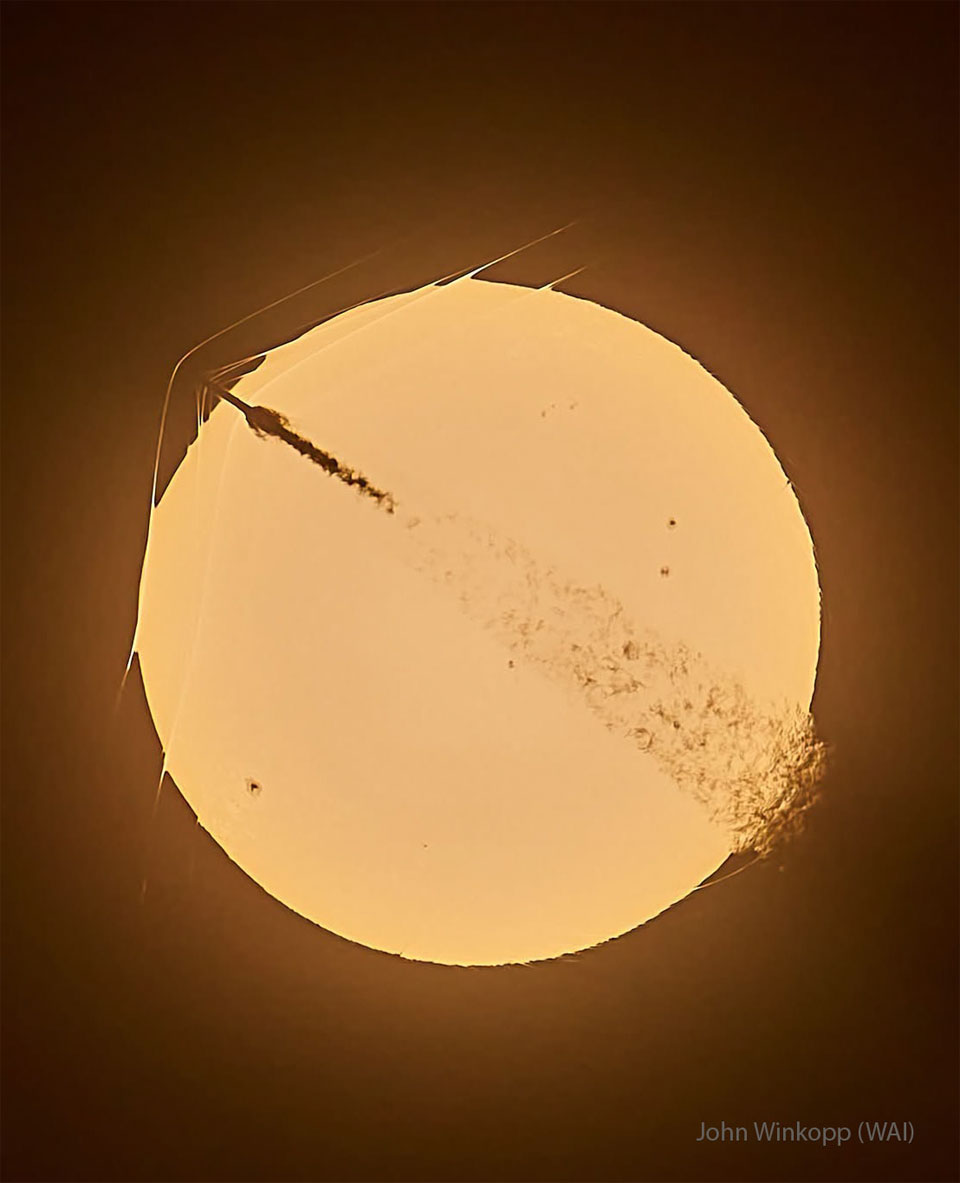
Credit: John Winkopp, WAI Media
Explanation: What's happening to this Sun-crossing rocket? The SpaceX Falcon 9 rocket, visible on the upper left, launched only about one minute before this amazing image was captured. As it rose to low Earth orbit from Cape Canaveral , Florida , USA , in late May, the rocket became supersonic before it crossed the disk of the distant Sun -- from the perspective of the well-placed photographer. The spacecraft's high speed caused bow-shaped compressed-air shockwaves to form across leading surfaces, with at least three visible even outside the Sun 's disk because they refract sunlight . The trailing exhaust caused turbulence visible on the lower right. None of this was damaging to the robotic Starlink 10-53 mission , which delivered 29 communications satellites to low Earth orbit as planned. And if that isn't amazing enough - the Sun had spots !
#APOD #Astronomy #Science #NASAInspires
https://apod.nasa.gov/apod/ap260615.html
Raw JSON
{
  "kind": 1,
  "id": "cef95c9d48beffd8f5a638374cc623ccc256891c49bd384aa5bc3312b2762939",
  "pubkey": "e85ed75286cb77475776c1007df8c4ff1c9c68eff91c3627347b065c5bf4dc78",
  "created_at": 1781496437,
  "tags": [],
  "content": "**Astronomy Picture of the Day**\n\n15 June 2026\n\n**Triple Shockwave from Sun Crossing Rocket**\n\nImage: https://apod.nasa.gov/apod/image/2606/TripleSunShock_Winkopp_960.jpg\n\nCredit: John Winkopp, WAI Media\n\nExplanation: What's happening to this Sun-crossing rocket? The SpaceX Falcon 9 rocket, visible on the upper left, launched only about one minute before this amazing image was captured. As it rose to low Earth orbit from Cape Canaveral , Florida , USA , in late May, the rocket became supersonic before it crossed the disk of the distant Sun -- from the perspective of the well-placed photographer. The spacecraft's high speed caused bow-shaped compressed-air shockwaves to form across leading surfaces, with at least three visible even outside the Sun 's disk because they refract sunlight . The trailing exhaust caused turbulence visible on the lower right. None of this was damaging to the robotic Starlink 10-53 mission , which delivered 29 communications satellites to low Earth orbit as planned. And if that isn't amazing enough - the Sun had spots !\n\n#APOD #Astronomy #Science #NASAInspires\n\nhttps://apod.nasa.gov/apod/ap260615.html\n",
  "sig": "dba711a5b1c64bf81f9296eef322a1caf53cb4fbdf97747f7dbbad62a02fbbb74d003f496697886e4720cccd4b0422a6d2205531f2ec4af42c7828c7660dba0a"
}