**Astronomy Picture of the Day**

npub1ap0dw55xedm5w4mkcyq8m7xyluwfc680lywrvfe50vr9ckl5m3uqtf5l75
hex
d667c0b3192f6db4e7e671cc2eef0ff253ebe7dda74a298ab6b8a42e524c4ba5nevent
nevent1qqsdve7qkvvj7md5uln8rnpwau8ly5ltulw6wj3f32mt3fpw2fxyhfgprpmhxue69uhhyetvv9ujuem4d36kwatvw5hx6mm9qgswshkh22rvka682amvzqralrz078yudrhlj8pkyu68kpjut06dc7qugfu6nKind-1 (TextNote)
Astronomy Picture of the Day
13 April 2026
Comet R3 (PanSTARRS) Brightens
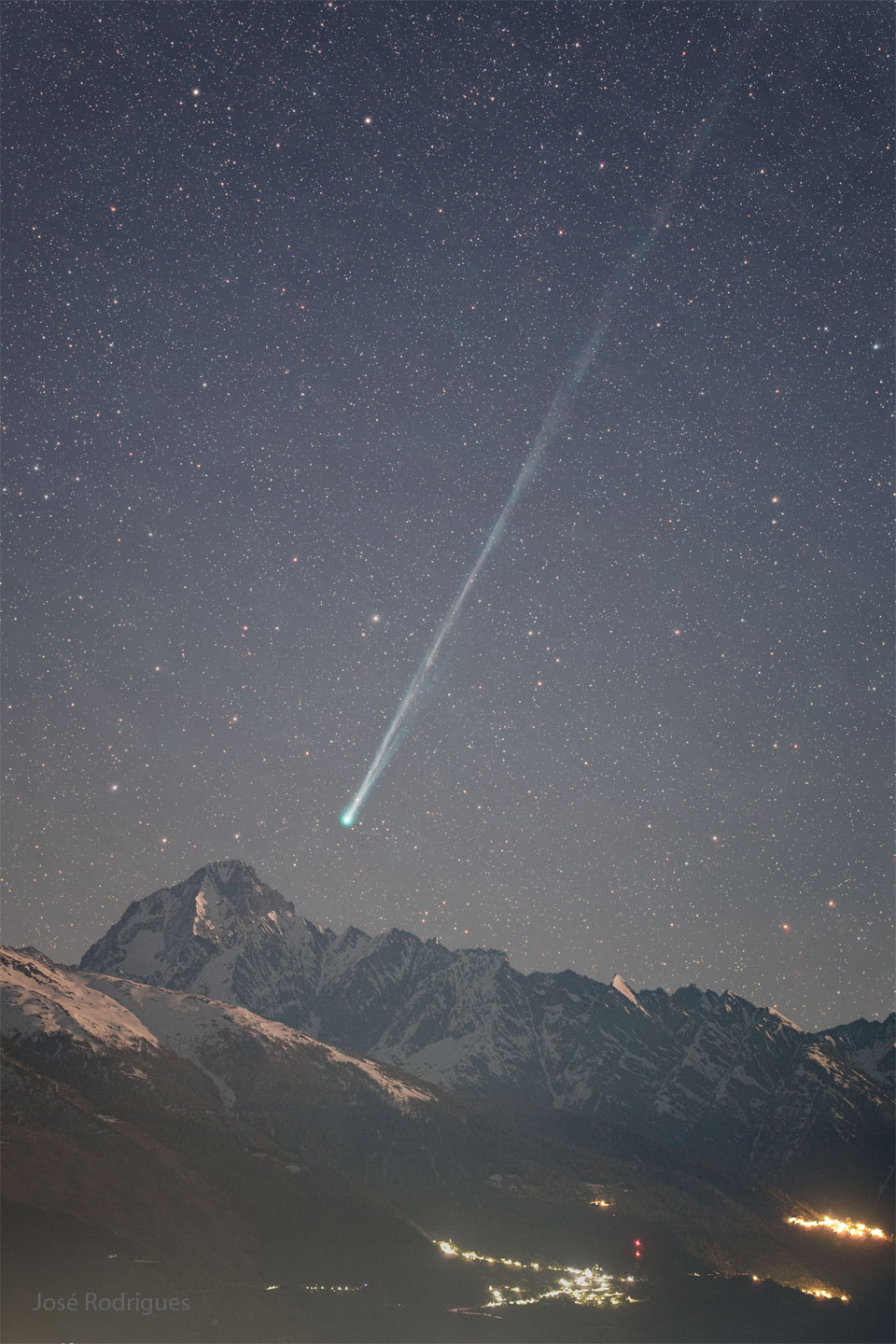
Image Credit: José Rodrigues
Explanation:
Comet R3 is brightening rapidly -- will it survive?
C/2025 R3 (PanSTARRS) has been slowly brightening and extending an ion tail since its discovery last year.
This shedding mountain of dirty ice puts on its best sky show this month, though, because it passes its closest to both the Sun (April 19) and the Earth (April 25).
The featured image, showing R3 already sporting a tail extending over 10 degrees, was taken two nights ago from Sion, Switzerland with the big mountain Bietschhorn on the left.
Comet R3 will be visible during mid-April before sunrise.
Although the future brightness of any comet is hard to predict, the brightness of R3 makes it already a good camera comet and it may become visible to the unaided eye in the next week.
Comet R3's physical future is also unknown because, like Comet A1 (MAPS) earlier this month, it may disintegrate when it passes its closest to the Sun.
Or it may live to leave the Solar System.
#APOD #CometR3 #PanSTARRS #Comet #Astronomy #Astro
https://apod.nasa.gov/apod/ap260412.html
Raw JSON
{
  "kind": 1,
  "id": "d667c0b3192f6db4e7e671cc2eef0ff253ebe7dda74a298ab6b8a42e524c4ba5",
  "pubkey": "e85ed75286cb77475776c1007df8c4ff1c9c68eff91c3627347b065c5bf4dc78",
  "created_at": 1776053695,
  "tags": [],
  "content": "**Astronomy Picture of the Day**\n\n13 April 2026\n\n**Comet R3 (PanSTARRS) Brightens**\n\nhttps://apod.nasa.gov/apod/image/2604/R3Panstarrs_Rodrigues_960.jpg\n\nImage Credit: José Rodrigues\n\nExplanation:  \nComet R3 is brightening rapidly -- will it survive? \n\nC/2025 R3 (PanSTARRS) has been slowly brightening and \nextending an \nion tail since its discovery last year. \n\nThis shedding mountain \nof dirty ice puts on its best sky show this month, \nthough, because it passes its closest to both the \nSun (April 19) and the \nEarth (April 25). \n\nThe \nfeatured image, showing R3 already sporting a \ntail extending over 10 degrees, \nwas taken two nights ago from \nSion, \nSwitzerland \nwith the big mountain \nBietschhorn on the left. \n\nComet R3 \nwill be visible during mid-April before sunrise.\n\nAlthough the future brightness of any comet is hard to predict, \nthe brightness of \nR3 makes it already a good \ncamera comet and it may become visible to the \nunaided eye in the next week. \n\nComet R3's physical future is also \nunknown because, like \nComet A1 (MAPS) earlier this month, it may \ndisintegrate when it passes its closest to the Sun. \n\nOr it may live to \nleave the Solar System.\n\n#APOD #CometR3 #PanSTARRS #Comet #Astronomy #Astro\n\nhttps://apod.nasa.gov/apod/ap260412.html\n",
  "sig": "c093900e38b79c75a6d6be6ccf2c133c2e4c3d5470a189716942dc54383f0de7c07384c7081e906d28519a1794b103b7892424bc5e7a61fcdd509c85cb07b0d7"
}