**Astronomy Picture of the Day**

npub1ap0dw55xedm5w4mkcyq8m7xyluwfc680lywrvfe50vr9ckl5m3uqtf5l75
hex
d781a23a2f4673df319c7d2a4fe669a4e3fb8c48a3a9aef5f3050622552a9f89nevent
nevent1qqsd0qdz8gh5vu7lxxw862j0ue56fclm33y282dw7hes2p3z254flzgprpmhxue69uhhyetvv9ujuem4d36kwatvw5hx6mm9qgswshkh22rvka682amvzqralrz078yudrhlj8pkyu68kpjut06dc7qzwdvfcKind-1 (TextNote)
Astronomy Picture of the Day
31 May 2026
Eagle Nebula Pillars in Infrared from Hubble
Video thumbnail: Link down bellow
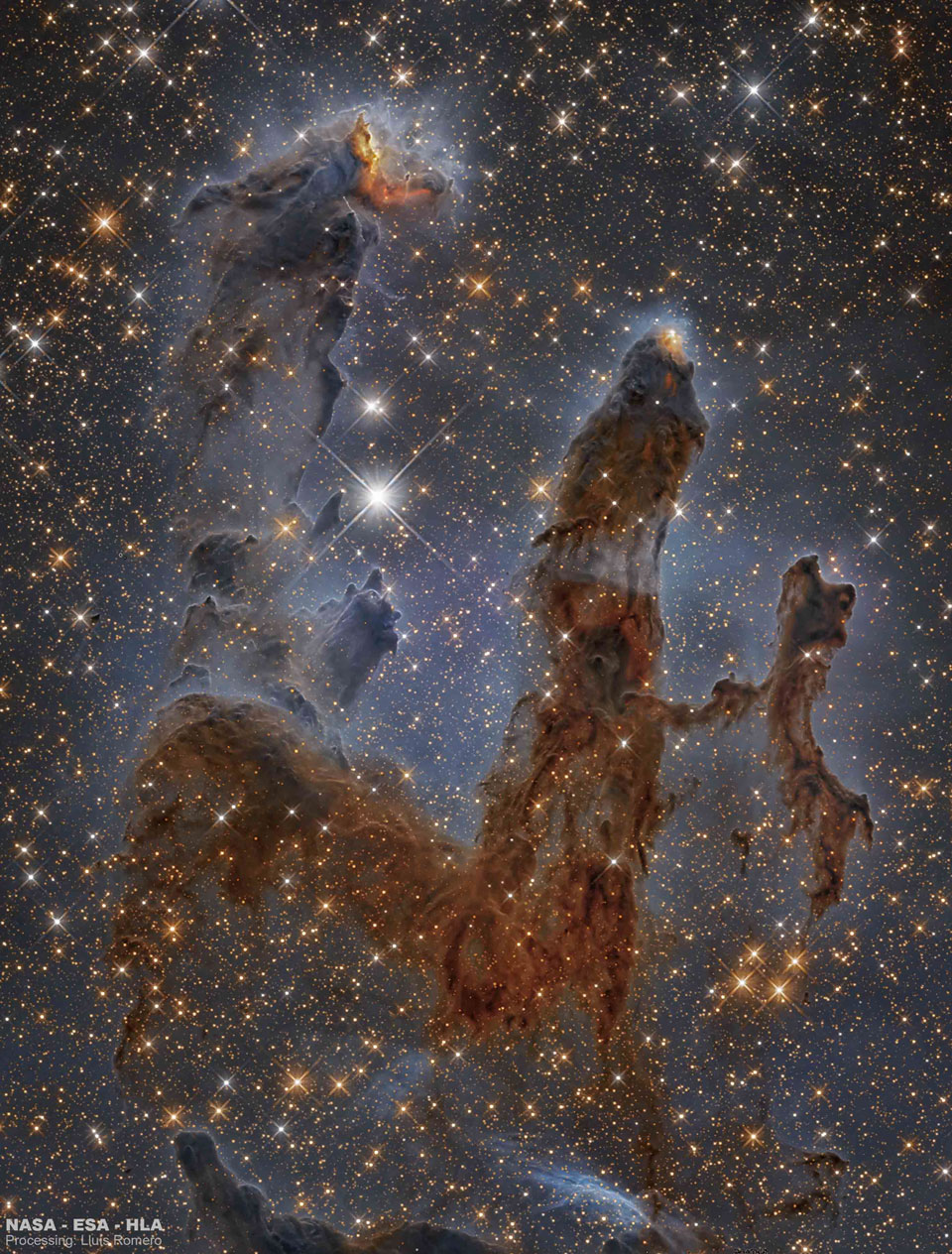
Image Credit: NASA , ESA , Hubble , HLA ; Processing: Luis Romero Ventura
Newborn stars are forming in the Eagle Nebula. They are gravitationally contracting in pillars of dense gas and dust. The intense radiation of these newly-formed bright stars is causing surrounding material to boil away. This image , taken with the Hubble Space Telescope in near infrared light , allows the viewer to see through much of the thick dust that makes the pillars opaque in visible light. The giant structures are light years in length and dubbed informally the Pillars of Creation . Associated with the open star cluster M16 , the Eagle Nebula lies about 6,500 light years away. The Eagle Nebula is a satisfying target for small telescopes in a nebula-rich part of the sky toward the split constellation Serpens Cauda (the tail of the snake).
#APOD #EagleNebula #PillarsOfCreation #M16 #HubbleSpaceTelescope #InfraredObservation
https://apod.nasa.gov/apod/ap260531.html
Raw JSON
{
  "kind": 1,
  "id": "d781a23a2f4673df319c7d2a4fe669a4e3fb8c48a3a9aef5f3050622552a9f89",
  "pubkey": "e85ed75286cb77475776c1007df8c4ff1c9c68eff91c3627347b065c5bf4dc78",
  "created_at": 1780200617,
  "tags": [],
  "content": "**Astronomy Picture of the Day**\n\n31 May 2026\n\n**Eagle Nebula Pillars in Infrared from Hubble**\n\nVideo thumbnail: _Link down bellow_\nhttps://apod.nasa.gov/apod/image/2605/M16Ir_HubbleRomero_960.jpg\n\nImage Credit: NASA , ESA , Hubble , HLA ; Processing: Luis Romero Ventura\n\nNewborn stars are forming in the Eagle Nebula. They are gravitationally contracting in pillars of dense gas and dust. The intense radiation of these newly-formed bright stars is causing surrounding material to boil away. This image , taken with the Hubble Space Telescope in near infrared light , allows the viewer to see through much of the thick dust that makes the pillars opaque in visible light. The giant structures are light years in length and dubbed informally the Pillars of Creation . Associated with the open star cluster M16 , the Eagle Nebula lies about 6,500 light years away. The Eagle Nebula is a satisfying target for small telescopes in a nebula-rich part of the sky toward the split constellation Serpens Cauda (the tail of the snake).\n\n#APOD #EagleNebula #PillarsOfCreation #M16 #HubbleSpaceTelescope #InfraredObservation\n\nhttps://apod.nasa.gov/apod/ap260531.html\n",
  "sig": "c5bf0c8b11da56d2869992d0e18302198ba127752252cc85851257da6b9f30f1ef86f4dabb2cc3725a9020d06acc1828a678fbc435c81a6ac5b4c13c4094fe7b"
}