**Astronomy Picture of the Day**

npub1ap0dw55xedm5w4mkcyq8m7xyluwfc680lywrvfe50vr9ckl5m3uqtf5l75
hex
dc51efbe1cd98743496c6c60fe30ef493fae58543d0f5df7468494eb9c8d19ebnevent
nevent1qqsdc500hcwdnp6rf9kxcc87xrh5j0awtp2r6r6a7argf98tnjx3n6cprpmhxue69uhhyetvv9ujuem4d36kwatvw5hx6mm9qgswshkh22rvka682amvzqralrz078yudrhlj8pkyu68kpjut06dc7qpg90xpKind-1 (TextNote)
Astronomy Picture of the Day
22 May 2026
The Nebulous Realm of WR 134
Image: 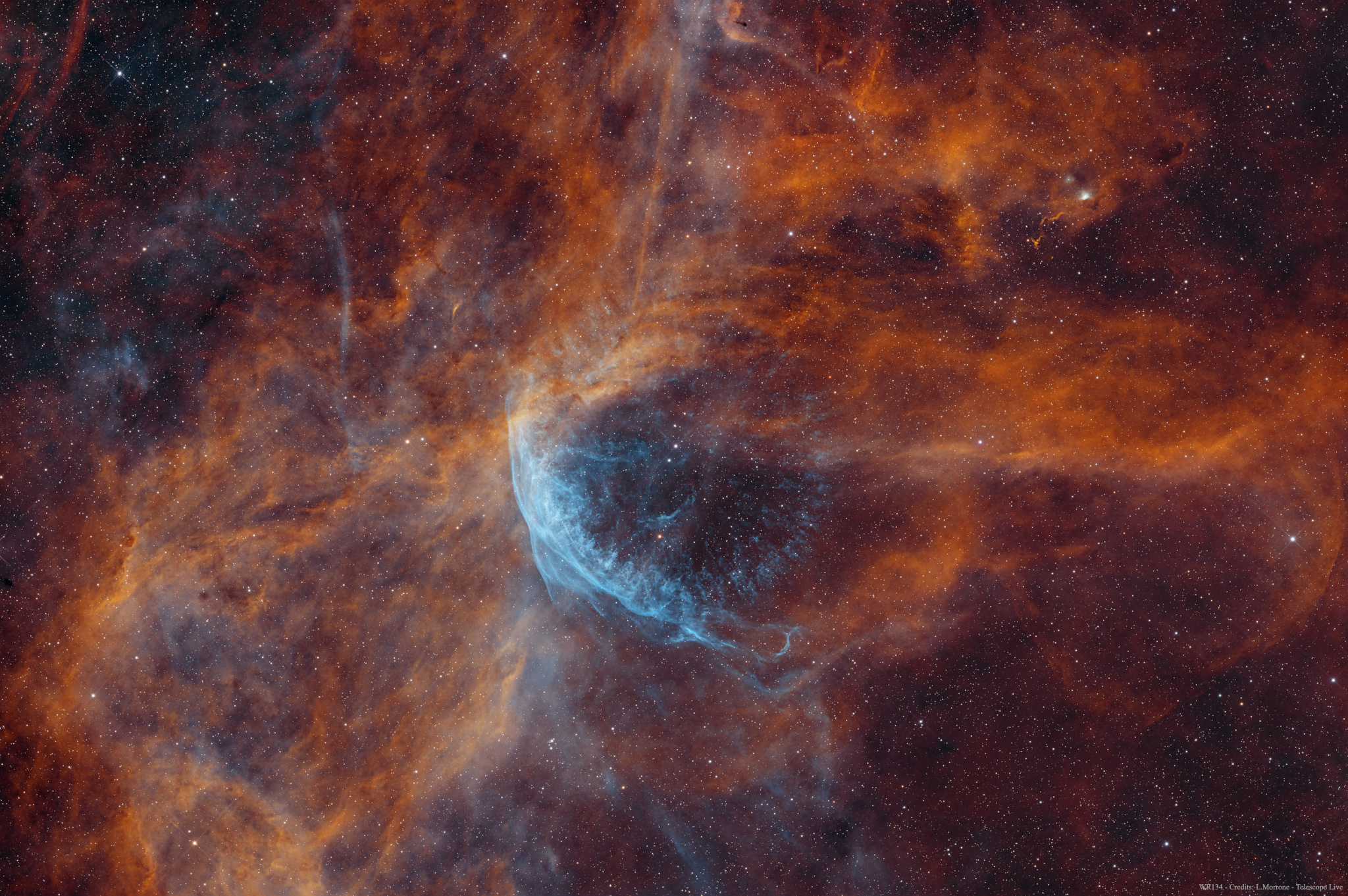
Credit: Not provided
This cosmic snapshot covers a field of view over twice as wide as the full Moon within the boundaries of the high-flying constellation Cygnus. Made using astronomical narrowband filters, the image highlights the bright edge of a ring-like nebula traced by the glow of ionized hydrogen and oxygen gas. Embedded in the region's expanse of interstellar clouds , the complex, glowing arcs are sections of shells of material swept up by the wind from Wolf-Rayet star WR 134, the brightest star near image center. Distance estimates put WR 134 about 6,000 light-years away, making this telescopic frame over 100 light-years across. Shedding their outer envelopes in powerful stellar winds, massive Wolf-Rayet stars have burned through their nuclear fuel at a prodigious rate and end their final phase of massive star evolution in a spectacular supernova. Their stellar winds and final supernova explosion enrich the interstellar material with heavy elements to be incorporated in future generations of stars .
#APOD #WR134 #WolfRayetStar #Nebula #Cygnus #AstroPhotography
https://apod.nasa.gov/apod/ap260522.html
Raw JSON
{
  "kind": 1,
  "id": "dc51efbe1cd98743496c6c60fe30ef493fae58543d0f5df7468494eb9c8d19eb",
  "pubkey": "e85ed75286cb77475776c1007df8c4ff1c9c68eff91c3627347b065c5bf4dc78",
  "created_at": 1779422760,
  "tags": [],
  "content": "**Astronomy Picture of the Day**\n\n22 May 2026\n\n**The Nebulous Realm of WR 134**\n\nImage: https://apod.nasa.gov/apod/image/2605/WR134morrone2048.jpg\n\nCredit: Not provided\n\nThis cosmic snapshot covers a field of view over twice as wide as the full Moon within the boundaries of the high-flying constellation Cygnus. Made using astronomical narrowband filters, the image highlights the bright edge of a ring-like nebula traced by the glow of ionized hydrogen and oxygen gas. Embedded in the region's expanse of interstellar clouds , the complex, glowing arcs are sections of shells of material swept up by the wind from Wolf-Rayet star WR 134, the brightest star near image center. Distance estimates put WR 134 about 6,000 light-years away, making this telescopic frame over 100 light-years across. Shedding their outer envelopes in powerful stellar winds, massive Wolf-Rayet stars have burned through their nuclear fuel at a prodigious rate and end their final phase of massive star evolution in a spectacular supernova. Their stellar winds and final supernova explosion enrich the interstellar material with heavy elements to be incorporated in future generations of stars .\n\n#APOD #WR134 #WolfRayetStar #Nebula #Cygnus #AstroPhotography\n\nhttps://apod.nasa.gov/apod/ap260522.html\n",
  "sig": "af9bf9b1a907772e23ba1e20eb43938275b642c24bcbf1bae5a231912229c29201c6a58958b9a4159f3156f89828b94c47a790a76fcc730d1dfbf85ac8cf09ff"
}