**Astronomy Picture of the Day**

npub1ap0dw55xedm5w4mkcyq8m7xyluwfc680lywrvfe50vr9ckl5m3uqtf5l75
hex
e44c9aa226f562e0648a0193cf29139034f431e8710fb3e439922455a2df3d4dnevent
nevent1qqswgny65gn02chqvj9qry709yfeqd85x858zranusueyfz45t0n6ngprpmhxue69uhhyetvv9ujuem4d36kwatvw5hx6mm9qgswshkh22rvka682amvzqralrz078yudrhlj8pkyu68kpjut06dc7qvljr7uKind-1 (TextNote)
Astronomy Picture of the Day
27 March 2026
Black Holes and Neutron Stars: 218 Mergers and Counting
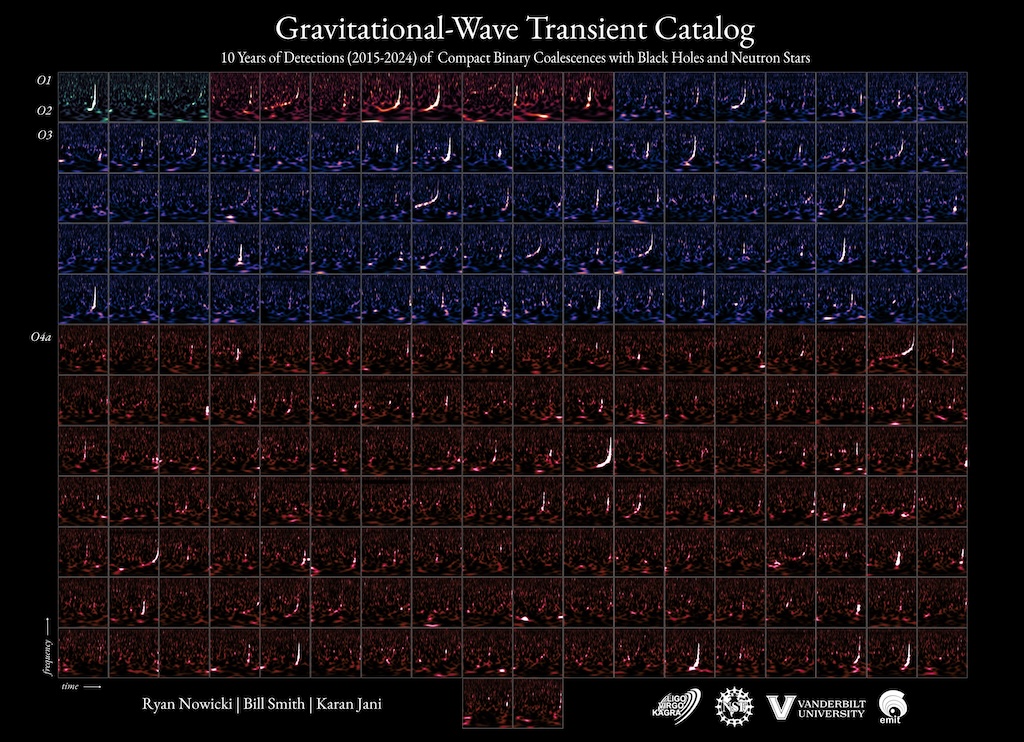
Image Credit: Ryan Nowicki, Bill Smith, Karan Jani, Cecilia Chirenti, NASA, GSFC, CRESST II
Explanation:
What is the sound of two black holes merging in deep space?
Sound waves don't propagate in vacuum, but gravitational waves do.
In 2015 we were able to "hear" them for the first time and confirm one of Albert Einstein's theoretical predictions.
Each square on the grid of the featured image represents one of the gravitational wave detections announced so far by the LIGO-VIRGO-KAGRA Collaboration.
These plots show how the binary pair accelerates in their orbit around each other towards merger: the rising frequency effect is called a "chirp".
Although there are significantly more neutron stars than black holes, most of the detections are binary black hole mergers.
That happens because black holes are heavier and their signals are louder and can be seen farther away, resulting in more detections.
These events are rare, and we don't expect to see one close by in our Galaxy any time soon.
But they are happening continuously throughout the cosmos.
#APOD #BlackHoles #NeutronStars #GravitationalWaves #Astrophysics #Universe
https://apod.nasa.gov/apod/ap260326.html
原始 JSON
{
  "kind": 1,
  "id": "e44c9aa226f562e0648a0193cf29139034f431e8710fb3e439922455a2df3d4d",
  "pubkey": "e85ed75286cb77475776c1007df8c4ff1c9c68eff91c3627347b065c5bf4dc78",
  "created_at": 1774585422,
  "tags": [],
  "content": "**Astronomy Picture of the Day**\n\n27 March 2026\n\n**Black Holes and Neutron Stars: 218 Mergers and Counting**\n\nhttps://apod.nasa.gov/apod/image/2603/GWTC4-Events-Poster-Landscape_1024.jpg\n\nImage Credit: Ryan Nowicki, Bill Smith, Karan Jani, Cecilia Chirenti, NASA, GSFC, CRESST II\n\nExplanation:  \nWhat is the sound of two black holes merging in deep space?\n\nSound waves don't propagate in vacuum, but gravitational waves do.\n\nIn 2015 we were able to \"hear\" them for the first time and confirm one of Albert Einstein's theoretical predictions.\n\nEach square on the grid of the featured image represents one of the gravitational wave detections announced so far by the LIGO-VIRGO-KAGRA Collaboration.\n\nThese plots show how the binary pair accelerates in their orbit around each other towards merger: the rising frequency effect is called a \"chirp\".\n\nAlthough there are significantly more neutron stars than black holes, most of the detections are binary black hole mergers.\n\nThat happens because black holes are heavier and their signals are louder and can be seen farther away, resulting in more detections.\n\nThese events are rare, and we don't expect to see one close by in our Galaxy any time soon.\n\nBut they are happening continuously throughout the cosmos.\n\n#APOD #BlackHoles #NeutronStars #GravitationalWaves #Astrophysics #Universe\n\nhttps://apod.nasa.gov/apod/ap260326.html\n",
  "sig": "a8a206e6204e28223a4b0838d63d34cf04700632003d7e0b048395710c3ddc981e5fa738acb5489652ea66a777f1c1efcf761d04f233be48abc94f9453973ba8"
}