**Astronomy Picture of the Day**

npub1ap0dw55xedm5w4mkcyq8m7xyluwfc680lywrvfe50vr9ckl5m3uqtf5l75
hex
ed052db67f79f35b7154f6590d8625b4a3cd68b7837ca7e489dc47cd4cbb99dbnevent
nevent1qqsw6pfdkelhnu6mw920vkgdscjmfg7ddzmcxl98ujyac37dfjaenkcprpmhxue69uhhyetvv9ujuem4d36kwatvw5hx6mm9qgswshkh22rvka682amvzqralrz078yudrhlj8pkyu68kpjut06dc7qnh3027Kind-1 (TextNote)
Astronomy Picture of the Day
03 May 2026
Trifid Pillars and Jets
Image: 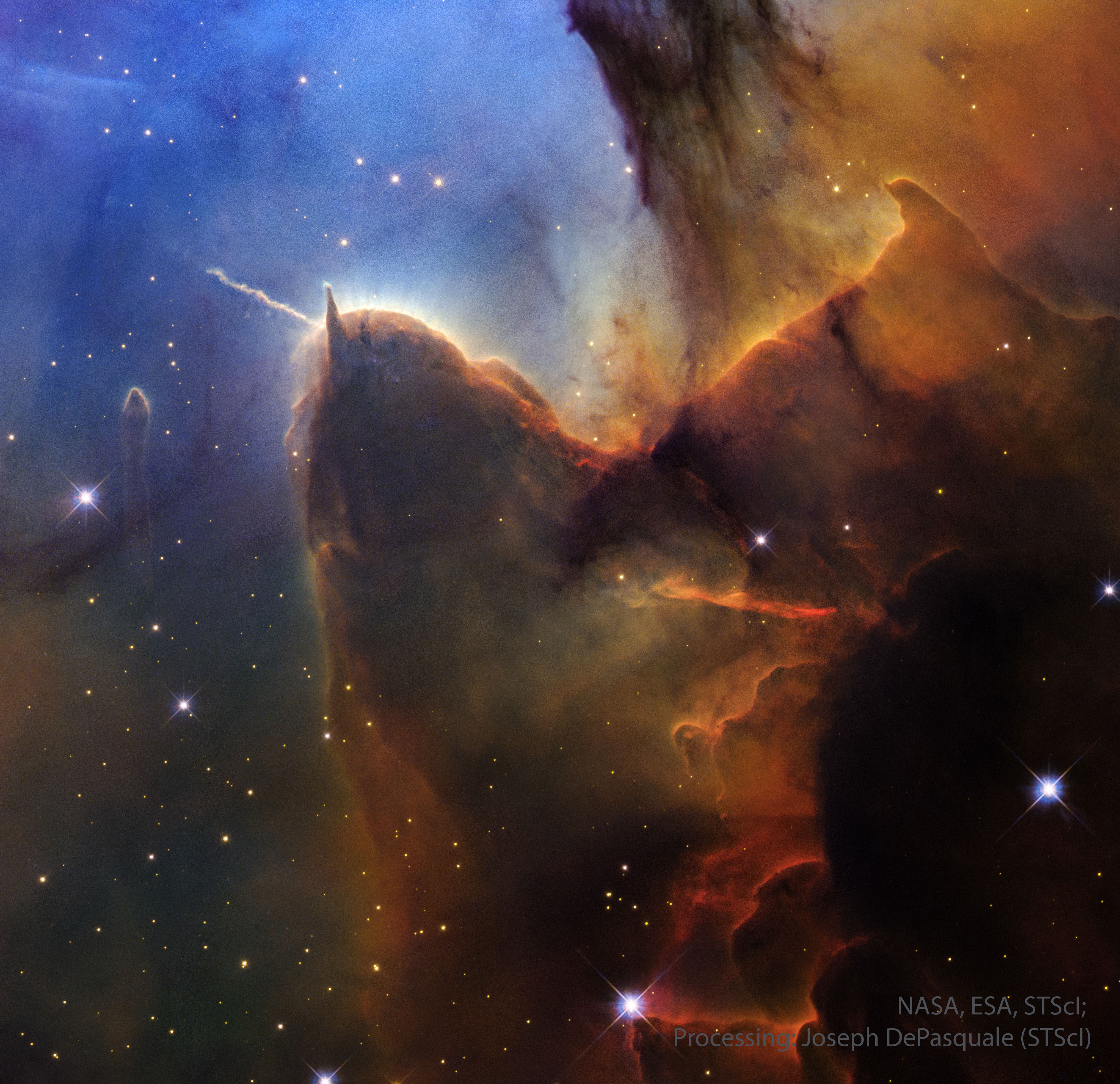
Image Credit: NASA , ESA , STScI ; Processing: J. DePasquale ( STScI )
Dust pillars are like interstellar mountains . They survive because they are more dense than their surroundings, but they are slowly being eroded away by a hostile environment. Visible in the featured picture by the Hubble Space Telescope is the end of a huge gas and dust pillar in the Trifid Nebula (M20), punctuated by a smaller pillar pointing up and an unusual jet pointing to the upper left. Many of the bright dots are newly formed stars . A star near the small pillar's end is slowly being stripped of its accreting gas by radiation from a tremendously brighter star situated off the top of the image. The jet extends nearly a light-year and would not be visible without external illumination. As gas and dust evaporate from the pillars, the hidden stellar source of this jet will likely be uncovered, possibly over the next 20,000 years.
#APOD #TrifidNebula #M20 #DustPillars #StellarJets #HubbleSpaceTelescope
https://apod.nasa.gov/apod/ap260503.html
原始 JSON
{
  "kind": 1,
  "id": "ed052db67f79f35b7154f6590d8625b4a3cd68b7837ca7e489dc47cd4cbb99db",
  "pubkey": "e85ed75286cb77475776c1007df8c4ff1c9c68eff91c3627347b065c5bf4dc78",
  "created_at": 1777781178,
  "tags": [],
  "content": "**Astronomy Picture of the Day**\n\n03 May 2026\n\n**Trifid Pillars and Jets**\n\nImage: https://apod.nasa.gov/apod/image/2605/TrifidPillar_Hubble_4074.jpg\n\nImage Credit: NASA , ESA , STScI ; Processing: J. DePasquale ( STScI )\n\nDust pillars are like interstellar mountains . They survive because they are more dense than their surroundings, but they are slowly being eroded away by a hostile environment. Visible in the featured picture by the Hubble Space Telescope is the end of a huge gas and dust pillar in the Trifid Nebula (M20), punctuated by a smaller pillar pointing up and an unusual jet pointing to the upper left. Many of the bright dots are newly formed stars . A star near the small pillar's end is slowly being stripped of its accreting gas by radiation from a tremendously brighter star situated off the top of the image. The jet extends nearly a light-year and would not be visible without external illumination. As gas and dust evaporate from the pillars, the hidden stellar source of this jet will likely be uncovered, possibly over the next 20,000 years.\n\n#APOD #TrifidNebula #M20 #DustPillars #StellarJets #HubbleSpaceTelescope\n\nhttps://apod.nasa.gov/apod/ap260503.html\n",
  "sig": "61aec9364d487e139e1b4e4d4aa110afa3c9603266241ba5cb873161b4796eb237b8d6ab6bb6c18e1e943b1a0f7814174c6c4a2defca0cdfe2c49d01cff1cb42"
}